Michael Garfield's Love Without End Tour Newsletter: Painting While Dancing
Showing posts with label Painting While Dancing. Show all posts

19 April 2010

Painting While Dancing, Part Seven: A Conversation With Kris D


(Republished from D/Visible Magazine. All images painted live by Kris D.)

After my last brief interview with live artist Kris Davidson, he and I decided that we hadn’t drilled quite deep enough into the mystery of what compels us both to paint. So over two weeks, while Kris was on the road in India and I was couch-surfing in Boulder, Colorado, we kept a lively correspondence about symbolism in art, mapping the unconscious, the visionary experience, anarchism, sacred geometry, and more. Here is the transcript of that conversation – an exchange that inspired us both to go even further sometime soon, that left us both delighted but wanting more:

Michael: I know you’re big about leaving the interpretation of your work to audiences, for the most part sticking to non-symbolic geometrical “landscapes” and the occasional fantastical and anonymous invertebrate seafloor flora. Why do you prefer to leave it so “faceless?” It seems like representational artwork makes it easier for audiences to connect to what the artist is doing…although in my own experience as a painter, it’s hard to completely improvise something satisfyingly real and recognizable and so sometimes my own preference for the abstract is less a critical choice and more about not making an epic experimental mess in front of people.

Kris: First off, the word “representational” in terms of artwork does not have to be confined to imagery from three-dimensional life. However, we humans live in a 3D reality and most representational art depicts this. Underneath our three-dimensional world is a geometrical architecture from which all matter comes forth. Generally speaking, sacred geometry is a way of describing this world through particular geometrical shapes and solids. My work is a process where I relate to these geometrical underpinnings, in an intuitive and hopefully poetic manner, and express it in a visual form. Though void of the 3D imagery in our day to day world, my paintings are still representational in that they are intended to point to what is underneath it all…and within us all. In terms of leaving my work “faceless” I wouldn’t say its necessarily faceless, its just that the face is perhaps…transparent. This ambiguous transparency allows for anyone to look away or look in. If someone looks in, their experience of the paintings becomes their own phenomenology. Geometry can suggest an infinitude of depth and information so someone can go as deep as they want to according to the capacity they have to delve. Personally, the use of 3D imagery gets in the way and I chose to fully dive into the pattern worlds a long time ago and it seems to be the most efficient way I have found to depict the mystic world that lies beneath it all…within us all… Do I lose some viewers because typical “representation” is lacking? Sure. Are compositions of shape and color still inviting for other viewers? Seems to be, so all of that feels perfect and fine by me.

Michael: That all makes sense in the context that a lot of the people who seem to connect most profoundly with work like yours (or mine, or Krystle Smith’s, or Adam Scott Miller’s) are either big into sacred geometry, or “the new physics,” or both. These alien topologies and perfect symmetries, intricate impossible knots and anonymous scapes that express a kind of nonverbal geometric hyper-language…these are all symbols and memes where various branches of contemporary spirituality and science seem to converge. Your work in particular is reminiscent of some of the physics diagrams popularized by unified field theorist Nassim Haramein, who is a kind of rock star in the electronic music scene in his own right via the emissary work of Jamie Janover. Nassim’s work points to the quantum vacuum as having exactly the same architecture as your work…but of course, he’s only made real waves in the last few years, so there’s a sense in which both of you are intuiting the same underlying reality. Leonard Shlain talked about this in Art & Physics, about how art explores a new paradigm in intuitive nonlinear ways right before (possibly even as a developmental precursor to) science coming in and systematizing the same understanding.

Add that to philosopher Ken Wilber’s discussion with Alex Grey about how Grey’s work is representational of deeper mind spaces, the entities and landscapes of “non-ordinary” (at least for us) realms of experience, and the whole “representational/nonrepresentational” divide starts to look pretty ludicrous to me. Grey’s training as a medical illustrator I’m sure has something to do with this, in the same way that my having worked at the University of Kansas Natural History Museum means that I’m coming at all of this with the eye of a scientific illustrator and the idea that I’m working on “subtle energy micro-flora” or “hyperdimensional entity portraiture,” an exploration of the field guide to these strange beings inhabiting the far reaches of our minds, a through-the-microscope version of Grey’s majestic paintings.

In Robert Venosa’s recent interview on Reality Sandwich, he mentioned how this kind of “visionary” work calls attention to unusual world-spaces and so many people don’t even recognize it as significant (in the case of your work or mine, they might not consider the piece representational). But, he says, that’s exactly what makes it subversive, because even if it doesn’t register with the rational mind, the imagery is still at work in the unconscious, familiarizing people with these ideas and ontological dimensions, priming them to accept the extraordinary as the mundane. And so grinds on the escalating threshold of what our evermore-hallucinogenic culture considers “visionary.” There’s something of this in your statement about how, “If someone looks in, their experience of the paintings becomes their own phenomenology.” Once you open your eyes to the work, it doesn’t matter whether you make sense of it as a particular thing or pattern or just an expressive gesture; the painting is your experience, it’s you, and there is definitely a meaning gap that interpretation rushes to fill. You might dislike the painting for being so stubbornly unfamiliar, or love it for being so spookily, unnameably familiar. Either way, stripping art down to its mathematical mother tongue definitely demands some kind of response, some kind of ritual-of-naming. Like when I got a betta fish in college and refused to name it and that drove my roommate nuts so he immediately insisted on calling it Freddy the Fish. It became an ongoing dispute, because the fish can’t recognize its own name so why bother, but on the other hand the human mind is desperate to have a handle on everything.

Kris: In regards to your statement: “stripping art down to its mathematical mother tongue definitely demands some kind of response, some kind of ritual-of-naming” I agree with you to the extent that by doing so, some kind of ambiguity is preserved for the previously mentioned reasons. I think the term “visionary” does this, generally. Regardless of the many ways this term can be interpreted, it still points to the mystical undercurrent that moves beneath and through all things as well as to the ineffable forces pushing the evolution of consciousness.

With respect to the tendency of the human mind to categorize as we explore I would say there would be a spectrum of sub genres with visionary art. On one side of that spectrum the art would be more emblematic and realistic (or representational, in the traditional sense…haha). As you travel away from that end of the spectrum, the artwork would gradually become more abstract and eventually geometrical as you arrive at the other side. In the middle of the spectrum you would find more integrated compositions of geometry and abstract forms meshing and morphing into emblematic or iconic elements. The closer you get to the geometrical side of the spectrum the more ambiguity you find in the art. As you mentioned this area of geometrical art represents a space where contemporary science and spirituality converge and there are a lot of visionary thinkers who’s research and ideas directly relate here. I think connecting these dots if you will is the best way to satisfy your tendency to name what exactly this is.

However, I don’t think the scientific illustrator in you could ever find satisfaction if you are wishing to categorize this realm and check it off the list as if you have just discovered a new species of sea flora or something. The elusiveness of this subject matter is inherent and necessary to how the art relates with people and their own perceptive constitutions. I think over-categorizing this realm and dissolving ambiguity could compartmentalize meaning and inhibit the potential of people’s interpretations.

Michael: When I say that stripping art down to the non-symbolic requires some level of naming and demystification, I’m not saying that it “should.” This is just something that people do, that you and I do, I mean look at us having this conversation about it! And I don’t think, either, that ambiguity must be “preserved.” I mean, it is an un-ripened mind that looks at even the tawdriest lay-it-all-out-there representational micro-realism and doesn’t see the blaring cloudless dawn of the unknowable. Unless I’m wrong, it’s the mystery in a thing that anyone is getting at with art, no matter what the content…if there is specific content, it’s about the mystery in that thing.
In general though I agree there’s this spectrum, although there is a lot of overlap, especially with photography where landscape or microscopic photography is abstract for the sake of recognizing universal scaling laws…molehills that look like mountains. Or even to an extent any paintings of mountains, because landscapes are always about the footprint of the wider process, and so in a sense are at least pointing to the abstract.

This is where I agree with you about things getting slippery, too – because are we talking about landscapes or portraits? Are these places or people, we’re expressing here? I certainly am a location, as well as an intersection, an expression, a runaway train, an ecology, a community…as argued by Lewis Thomas and Lynn Margulis, the whole individual-as-collective turn that biology started taking back in the 60s and 70s and is now the basis of a theory of self-organization that mainstream science isn’t quite ready to accept: that this mysterious creative outpouring, this evolutionary explosion, occurs constantly and simultaneously in all directions along all axes on all levels of magnitude in all dimensions (and of course that means it doesn’t appear that way from an equal infinity of positions).

Anyway, when you say, “I think over-categorizing this realm and dissolving ambiguity could compartmentalize meaning and inhibit the potential of people’s interpretations,” I agree with you to the degree that slapping a name on something does tend to turn off a person’s brain, does allow them to think they know something when they really have no clue. No clue as to what? The ineffable mystery it continues to express. So in that sense, we really have nothing to worry about, there’s no way to squash the mystery.

I just want to make the distinction between description and explaination…learning to describe something like your artwork in the language of science doesn’t kill its elusive unspeakable truth anymore than (to borrow from Richard Dawkins) Isaac Newton’s explanation of how rainbows occur killed our wonder at the world or even at rainbows. To go a step further, I agree with Kevin Kelly that scientific exploration actually discovers more questions than answers, and so is in a sense not the exponential expansion of knowledge so much as it is the exponential expansion of our territory of ignorance, what we know we don’t know. And so in that sense it’s a far more efficient tool of mysticism than any religious or spiritual doctrine. We get to keep the left brain engaged, get to keep our analytical selves interested, without sacrificing awe…so long as we can remember that whatever interpretation we use is temporary scaffolding for the deeper and more mysterious models to come.

It’s like the Hakim Bey, Temporary Autonomous Zone thing: “The Empire was never founded; Chaos never died.” That zen trickster boot-to-the-head inherent in work like yours doesn’t go away, no matter how many people talk about its relationship to unified field physics, Egyptian mystery schools, postmodern architecture, etc.

Speaking of Bey, I wonder how your philosophy about these things informed your more biologically-inspired work, like the 2007 paintings with little seafloor creature type figures in them? And how your passion for specific strains of political philosophy has cross-pollinated and co-evolved with your larger worldview (to use a mixed metaphor with two mixing-themed metaphors)?

Kris: I agree with what your saying in regards to the distinction you make between description and explanation. Couple that with the fact that we are close to saying the same thing on that subject, I’m going to move on to your last question…

In regards to the “seafloor creature type figures” or the “fungi structures” as some people have called them…or “alien plant forms…” Whatever you want to call them…ha…I suppose everything I’m absorbing through the senses and the mind had some influence on them emerging, but honestly they first came about after a DMT trip. At the time I was sort of living bi-coastally, splitting my time between San Francisco and this spot in the middle of nowhere Georgia. A little country town called Ila that pretty much consisted of a house here and there and miles upon miles of cow pastures. I would trek into the middle of these pastures where the grass was overgrown to three or four feet high and carve out a little spot to sit. It was summer, so there were all kinds of bugs and insects throughout the grass.

One day, while doing this and coming out of a DMT peak I moved through the typical geometries that I see and hovered into some kind of collective psychic field shared by me, the grasses, and the grass hoppers. After this I wandered back to my studio and started drawing what was to be the first of these little plant forms. I’m not sure what they are or what they mean, but the creation of them is informed by all of my geometrical stuff even though they are asymmetrical and completely different forms.


As far as my interest in political philosophy goes, it is something that gives a grounded and tangible voice to the foundation of interconnectedness that geometry has rooted into my brain. If I had to pick one word for a message that these geometrical compositions say, it would be “interconnectedness.” Everything there is,is connected in some way, and the play of geometrical forms celebrates this. Applying this to political history and philosophy I get to an Idea of free market meta-anarchism. Somewhat of a utopian ideal not necessarily applicable to mass humanity in the present moment, but nevertheless an ideal of humanity’s potential.

Michael: That’s totally a missing piece, here. Insofar as mapping goes, andvisionary art as descriptive of some mysterious experience, as an attempt to give it more form and bring it into the public realm for investigation, I think there’s a kind of scientific necessity to explain where we are going to find these things, where to look for them. “The methods of visionary art”…I have seen several attempts to codify this, and most of them say that unlike some art forms, this one is totally explicit about its means. And I think the reason why is because we are dealing with subjects that hang out on the border of comprehension, at least we can kind of map them out and say, well, these are the forms I see when I’m on the verge of sleep. These are the forms I see after I just ran a few miles. These are the forms I see when I’m sitting in a summer meadow surrounded by the buzz of insects and having a tryptamine vision…this kind comes before a certain point, and this other kind comes after.

The thing that getsme is that these “findings” are repeatable. I think anyone with an experience like that in a similar context probably recognizes thoseforms and ascribes to them the same sense of externality, of beingalive beyond the scope of one “hallucinating” mind. And that’s whyI’m stuck on the relationship between the curvier and the more angular elements of your work…as if we’re looking alternately at the chemistry and the biology of this world, zooming through orders of magnification. At least, that’s how my own mind appears to be frantically making sense of things. With respect to how your art and political philosophy are united in this notion of geometric interconnectedness, one thing that is really impressed upon me by your work is how fluid you have made these very crystalline geometries. They branch andreconnect, spilling across your grids in multiple directions with avery strong sense of flow even with the sharp angles and the perfectsymmetries. Sometimes it seems to me like muddy water flowing throughchannels cut into quartz, or fabricated from molten plastic. Neitherof those is really a good metaphor for the free market meta-anarchism,though.

More like the cosmic geometry that inspires your work and the kind of harmonious mutualism necessary for a peacefully anarchic state are both obvious from a certain perspective, at a certain point in spacetime, in a certain state of mind.

Kris: This is a great response, Michael, that really brings me back full circle and beyond to how we started this discussion, the idea of me leaving things with a certain veil of ambiguity around them. As mentioned, I do that to leave the audience no limits to the meaning they can decipher as well as no influence on what is actually deciphered. On a personal level, I don’t feel any innate desire to define my paintings in the detail that they are rendered visually or to give any scientific explanation of them. For me they just are… They are a poetic interpretation to something mystic, something so ineffable [and impossible to] articulate in words that the visual medium has proven to be the most efficient way for me to express, this is-ness.

However, I am open any one else’s interpretations and innate tendencies to define or explain. On a personal level, you seem to have more of an inclination to satisfy your mind’s need to make sense of things in a more scientific language. I fully honor and respect that as a facet of this emerging community that I am a part of. If yours or someone else’s scientific mind comes up with a relevant description of the geometries that were discussing here and it plants a meme in the community that resonates with likes minds and then becomes a more permanent part of the lexicon of visionary culture, then I am in full support. I am open to that as I put these paintings out there.

It’s interesting, the perspective expansion and shift I’m experiencing as I travel through India and grow more immersed in this ancient culture. In terms of spirituality and consciousness expansion, this culture has been refining various methods of facilitating these things for eons. On a level of cultural maturity the Indians would be at the top of the pyramid in this department. I see a lot of Westerners over here that seem to have dropped their past and have fully adopted the Indian ways of spirituality.

I understand that if you are coming from a place in the Western world that is void of spirituality and you find that here, then you may renounce your roots and embrace the things that are transforming you in the Indian culture. However, as interconnected as visionary culture is with aspects of Indian culture, it is still originating from the void left behind by a materialistic western culture. Therefore the integral consciousness that visionary culture speaks of is growing out of the fragmented consciousness of the mainstream West. It is something that is more embryonic in comparison to the mystic modalities of ancient India. As this culture grows through the current embryonic stages, a community of visionary-minded individuals pushes the development by the nurturing of their inherent talents and passions and then sharing them with the community of like minds. Over time, something that is esoteric becomes more accessible by greater segments of the community and a cross pollination of people’s work enriches and develops the culture further.

Seeing this pattern humbles me and encourages me to share what it is that I do with a trust that other people such as yourself can pick it up and add to it; In this case, expanding the potential meanings of these geometries in terms that may exceed my personal capacity to scientifically explain.

“Muddy water flowing through channels cut into quartz” may be one of the better metaphoric responses I have ever heard. In terms of an embryonic visionary culture going through various transformations necessary to evolve closer to an ideal such as a “free market meta-anarchism," this may actually be a perfect metaphor. As abstract as the connection is, it’s still connected there.

14 March 2010

Painting While Dancing, Part 6: Advice To An Aspiring Live Painter


My motivation for performance painting developed over the last few years from “Jeez, I can do that!” to “I am in this to inspire people.” Consequently, it is evermore important to me that I share what I am learning through all of this. At the same time, repeatedly declaring this intention seems to attract a growing number of peers who seek guidance for living more harmoniously with their gifts and passions. Sometimes I am asked specific technical questions, but most of the time the yearning arrives something like this: “I really just want to know how to begin painting at shows and earning money doing it…”

Which really isn’t one question, but two. There’s an “and” in there. It’s the kind of question I might normally answer off the cuff in person, but since this whole game of mine is about living as a gift I figure it makes more sense to organize my thoughts somewhere they can be retrieved by other interested parties (both as a learning resource for other artists and so I can look back on this and laugh). So here is my own limited grasp of how to answer this twist on an ancient question: “How can I do what I want with my life?”

I got my start painting at concerts in Boulder, Colorado, which is positively saturated with live painters. This has good and bad consequences: on the one hand, it’s a recognized and enjoyed aspect of the culture; on the other hand (and I didn’t realize this for the first year or so), it means anybody who wants to make it with live art is on the wrong end of the supply/demand equation.


In some cities, I have found it is much easier to “brand” myself as something unique and exotic, desirable for my novelty and thus worthy of pay. Put me on a flyer and people will go, “Live painting, what? Oh really? That sounds awesome!” In Boulder and Denver, there was never that kind of mystique, and so getting paid there to do this work is pretty much out of the question. People like John Bukaty, who have been paid thousands of dollars to paint live for corporate audiences, often have to appeal to venue owners so they’re not required to purchase a ticket to get into the show. It’s a tricky situation, because as I am coming to understand more and more every day, you really do have to demonstrate your worth in ticket sales to the producers, no matter what kind of performer you are, and no matter how many people thank you personally during the show.

(Maybe getting people to sign some kind of statement at each show would help: “I loved having this painter here, and yes I’m willing to pay another dollar or two a show to support this person coming back.” I haven’t tried that. Yet. But I might give it a shot, especially in a busy scene like Colorado’s Front Range. Alternative payment ideas, ideas that sidestep event planners and venues to tap the appreciative audience directly, are worth some discussion between live painters and other fringe movements.)

Back on to the positive end of this, it was remarkably easy to get my start in a market like that because since I wasn’t initially trying to prove myself as a pay-worthy performance artist, I was generally free to show up and do my thing, so long as I had the good graces of either the artist or venue. Exactly whose permission you need depends on the show – it’s important to figure out which local venues are happy to have painters without prior notice, and which require that the artists include you in their production sheet. The first time I ever “painted” live, I was at a show with two more experienced live artists, borrowed an easel from one of them, worked with a headlamp I tied questionably to the easel’s top post, and worked with brush-tipped Faber-Castell markers on a sheet of white foamcore board with transparent glossy gridlines. Twenty inches across and thirty inches high was larger than any drawing I had ever made by a factor of at least four. And I had zero training in the fine art of painting. In other words, I was horrifically unprepared.


But it didn’t matter, because I was allowed to grow and learn in a low-pressure environment where I was “under the evolutionary radar” so to speak – I was not improving or worsening the “fitness” of the show by affecting ticket sales. I wouldn’t be there if I weren’t painting, so I wasn’t costing them anything to host; on the other hand, I wasn’t professional enough to really be considered an asset, exactly. It was a lovely place to be while I sorted out the basic features of my style, my equipment, my presentation, my conduct.

This all makes sense from an evolutionary perspective: radical new mutations usually emerge on islands or in other small populations, or on the fringes of larger populations, where there isn’t as much resistance from the “status quo.” (In biology, this is governed by the mechanics of genetic drift, where even a fabulously beneficial new mutation is likely to get lost in the noise. Likewise, it is a lot easier to get everyone on board your idea when you’re dealing with hundreds of people, instead of millions. And it’s why every big company has a “skunk works” where new ideas can be nurtured without interference from corporate boardroom inertia during their early, tender stages.)

So for getting started as a live painter, my recommendation would be to start with fairly small and inconsequential gigs where you are able to test new things without putting anybody’s reputation on the line. Experimentation is an eternal and definitive element of live art for most of its practitioners, but those first few shows are almost guaranteed to be sloppy, anxious, exciting, and kind of awkward as you get used to new issues like having an audience and time constraints. (It’s a bit like losing your virginity in this respect.) This is especially true if, like me, you dive right in not only with an alien context for your work but also unfamiliar media.


One of the best things about live art is that the artist gets real-time feedback during the show. Putting your work in front of a smaller audience and inviting people to talk to you while you work (especially other artists, if you’re lucky enough to have them around) is incalculably important, in terms of clarifying your own artistic intent, techniques, and direction. When I started in Boulder, the audience was more familiar with live painting than I was. They had many, many excellent suggestions and recommendations for bringing my work up to a more professional level while still cultivating my own personal style.

Individual and collective realities weave one another into being – it is obvious that individual realities gather to create a consensual “objective” truth; it is less obvious that these agreements create the environment out of which individual, “subjective” reality emerges. It’s easy to not give a damn what your critics think when you complete your work alone in the studio, and another thing entirely when people can just walk up to you and tell you what they think and feel about your work. After all, if you really don’t care about public opinion, then you probably don’t care whether your work has a positive effect on anyone, and you should probably examine your motives.

I’m not saying anyone should kill themselves trying to consistently integrate the competing commentaries of whosoever is brazen enough to walk up and speak their mind. Rather, that working in public creates a permeable boundary through which information can flow and the evolution of the work can proceed more rapidly, more responsively, more organically – all the while centered in as clear an artistic intent as possible. None of the live painters I know are above this, although many of them get away with only positive feedback. Which is kind of unfortunate, really, because knowing when to listen and when to ignore your critics is hugely important to cultivating a meaningful connection with your audience.

(Written for d/visible magazine.)

11 January 2010

Painting While Dancing, Part 5: Live Art Is Nonsense


Setting up an easel at concerts and inviting people to watch as you paint (or sculpt, or arrange flowers, or whatever art form you do that is more typically hidden from prospective audiences) is…different.
Most art forms are kept hidden in the studio until some dramatic Moment Of Unveiling. Instead, the transparency of performance makes this strange behavior distinct enough to deserve a name that will set it apart in people’s minds from the rituals and religions of conventional studio art. Process becomes an obvious, living part of the piece. Journey and destination take on new meanings. Since music, dance, and theater evolved in context as public entertainment or ritual, they belong in a separate category (especially those composed beforehand). In fact, it is the very change of context that makes something like performance painting strange in the first place.

People have taken to calling this kind of thing “live art.” It is probably better than nothing; but insofar as it is used to realistically distinguish one kind of creative expression from the rest, “live art” is nonsense.

For one thing, all artwork is part of what biologist Richard Dawkins calls “the extended phenotype.” Just as the spider’s web is as much an extension of its own genetic code as the spider itself, the artifacts and implements of art are part of the artist’s own breathing body. (It is, after all, called “a body of work.” If you think this kind of literalism is a stretch, try taking scissors to someone’s latest opus. They’ll act like you’re about to amputate a limb. As for tools, recent neurological research demonstrates that after just a few minutes using a hammer, our brains remap our bodies to include it as part of our arm. The brush or violin or laptop is, in some unutterably strange but natural way and in spite of modernist notions to the contrary, a cherished organ of the artist. Humans are cybernetic creatures, self-modification ubiquitous among us.

As linguistic beings, we are constantly in the game of renegotiating this self/other boundary. We supplement ourselves with expression-augmenting toys; hang names and titles on them like we are decorating a Christmas tree; plant flags in the ancient, wild terrain of the body and claim it for the egoic waking state (although clearly selves change over time…we hang onto our story of continuity in spite of overwhelming evidence to the contrary).

Take this other-as-self line of reasoning far enough, though, and you end up in a world that is entirely alive and looking back at you from everything. All perception is focused by history, all thought is woven of language, and we all only see mind in all directions, only feel mind in all directions. It isn’t the best argument for why “live art” is a nonsense term.

Therefore also consider that we are all witness to, and the declared actor responsible for, many of the things we do. Not even most, but many, and motivation is a very real dimension of any creative act. Who are we trying to talk to? In the act of art, especially in the flow states common to total participation, a deeper eye is watching. Audience feedback still informs the piece, because every work of art is a performance, even if it is for an audience of one. Even if we think we are only playing to satisfy the compulsions of our chattering minds, awareness itself is the substance of our perceptions and the basis of even our lowliest attempts.

Some people get religious about it, building churches and the like. Throughout history, it seems, the greatest works are those made from an awareness of the wider mind that watches. In that kind of harmonious duality, the uncharacterizable observer can not really be called “alive,” and so the job goes to the artwork.


Again, that kind of absolute statement gets us nowhere; so let’s add a dimension.

Every work of art – not just music and dance, but also architecture, painting, poetry, sushi – is created in and through time, something that grows and changes, moves and breathes on its journey to completion. No matter how well planned, all art has improvisation at its heart, and is thereby connected to the same creative force pulsing through the quivering leaves and darting fish. The product is inextricable from the process. Some art forms emphasize this; Zen calligraphy and expressionist paintings are especially transparent about it.

Among so-called “live artists,” however, the evolutionary nature of art is key. For those who make visual art a public performance, the focus is on reflecting, not necessarily capturing, the energies of a specific moment. Live painter Norton Wisdom, who has been in the game longer than anyone, works on a plastic sheet he wipes clean after every show. Others continually paint over the same canvases. Just like more conventionally-defined life forms, some paintings leave fossils and others vanish into the stream of time.

(Written for d/visible magazine.)

16 April 2008

Painting While Dancing, Part 4: The Danger of Creativity

Icarus Falling, by Paul Ambroise Stoldtz, 1743

Painting is dangerous.

We don't typically think of painting as dangerous, because we imagine the landscape print in our motel room to have emerged uncomplicatedly from the sweatless brow of some middle-aged homebody with a neat row of clean brushes and a comfortable desk chair. We are the children of Late Capitalism, recognizing product over process. Our physicists are busy looking not for fundamental relationships in the universe, but fundamental particles. We seem not to really grasp the wisdom in statements like, "Happiness is a journey, not a destination." Machines build things for us.

Through clever modern chemistry, being an artist is almost totally non-toxic. You don't even have to get your hands dirty; just use an electronic stylus and tablet, and you can do more with pixels than you ever could have with messier media. And you can do it sitting down.

Even the treacherous borderlands of the mind have been neutered, packaged, labeled, and thus contained. Psychedelia is trite. Been there, done that - our chain retailers advertise with swirling floral blooms and rippling waves of color with an otherworldly richness that puts every Boomer album cover to shame.

Maybe acid did break our parents' chromosomes...or maybe we, like the kids of those Brazilian shamans, have just been innoculated to these deeper weirdnesses by growing up inside of them. Maybe consumer culture just gives us too much to experience, and we've grown even thicker shades to wear as we parade into the Light.

Aliens, angels, ascended masters? Oh yeah, my buddy channels them. Bilocation? I did that, once. We're living in a world that is rending the minds of our parents to tatters, and it's No Big Deal. The extraordinary is, like, so totally ordinary.

But I don't blame any of us for blinding ourselves to the incredible intensity of our age. After all, we're dealing with what Rudolf Otto called the Mysterium Tremendum - the deep unknown at the heart of the world that is so beyond our ken that we could not survive the knowledge. We cower from the face of God for good reason: that creative Source is a burning brightness of which fire is only a cool, pale imitation. History can be read as the story of one daring soul after another throwing itself into the flame, hoping to capture a spark. Our lineage is one of suicide missions, artists and scientists sacrificing themselves for the greater knowledge and experience of the collective.

I believe that the danger of creativity never really went away - it just moved, leaving a sediment of the once-extraordinary behind as it rolled outward like cooling lava into the sea. We live on what was once the boiling coitus of elements - now the terra firma, solid and predictable terrain. Genius and Madness are neighbors because they move fast enough to stay ahead of everyone else, snapping up beachfront property as fast as it is made. (Madness just builds a slightly shoddier house, slightly closer to the tide.) And playing around on the edges is inherently dangerous. In any form, creativity challenges preconceptions, digests conventions, and throws us to burn and drown in the intensely unfamiliar. It changes who we are. "Being creative" is agreeing to an adventure from which nobody has ever, ever returned.

The deep blue pigment bygone painters used for sea and sky was cobalt - it drove them insane with chemical poisoning. Nature photographers have a bad habit of being eaten by wild animals or falling off of cliffs. The most gifted musicians seem especially likely to drown or overdose. It's a common myth across ancient cultures from Africa to Athens that the best artists inherit their talent through deals with water spirits - deals eventually repaid with blood.

(For more on this mysterious phenomenon, I encourage you to read up on the Saturn Return and the 27 Club.)

The Muse - actually an entire coterie of entities that the Greeks held responsible for inspiring every creative act - is a lunar, feminine archetype. The muses were water nymphs, legendary for blinding those arrogant enough to challenge them.

Honest artists admit that they can claim no ownership of their creative work - that it emerges through them, and not from them. And like the biological creative passion of our sexual inheritance, artistic creativity drives us into all kinds of self-destructive recklessness in order to satisfy its own expansive urge. The Muse does not care about you, except as a means to an end. The island on which we perch our traditions is literally built from the bones of artists and scientists.

I think about this a lot, when painting at concerts in front of a heart-rattling beam of sound. I may not have to worry about carcinogenic paints devouring my brain, but that doesn't stop me from feeling like I make my living like a deep sea creature on periphery of a hydrothermal vent, somehow surviving on the narrow ledge between crushing pressure and unbelievable heat, thriving off the rich intersection of extremes. Those benthic creatures lay root at the sweetspot where the ocean carries sustenance directly into their blood - and I plant myself right where a wall of tidal music energy is sieved through my energetic body into crystalline patterns of paint. These images are the love child of the audience's and performers' energies feeding back over a massive electrified circuit, leaving cross-sectional deposits in opaque pigment on a black board - a kind of spectrograph of the evening's collective resonance, deformed and amplified by the matrix of my interpretation.

And this is matter-of-fact science. Chemist Ilya Prigogine won a Nobel Prize for his theory of dissipative structures - the gist of which is that order emerges when so much energy flows through a system that it must reorganize into a higher level of complexity. If it can't keep up with the surge, it is totally destroyed.

Necessity is the mother of invention, just as whirlpools form because the river's current is constrained by the lay of the riverbed. Life is the floret that pushes forth from the equal and opposite vectors of structure and chaos. And so, like Robert Johnson (a member of the 27 Club), I find the soul of my artwork at the crossroads. That's about as deep a truth as I have ever known: that creativity lives in between things, balanced on the head of a pin, spilling from the broken crust of opposing forces.

Putting in my earplugs comes with a sense of frontier glee akin to what I imagine a welder feels when lowering the mask: the pride of having to wear protective equipment so I can play on the turbulent edge of knowing. I didn't think to bring any on my first night out painting, and my ears rang afterward for an entire day. Working on fine art in a crowd of hundreds of drunk dancers requires a special awareness of the space around me, should any teetering reveler pitch over into my easel or elbows. Keeping a dance party schedule means getting to sleep at hours that can't be good for my health. After five consecutive nights of painting, my legs begged for days to wobble out from beneath me.

And even in this supposedly enlightened age, I still have to work in a cloud of noxious fumes if I want to use gold or silver paint. (It's funny: When I was a child, I acted in a public service announcement declaring the dangers of huffing paint. I was the "bad kid" who didn't learn his lesson from the hospitalization of his friends...and now here I am huffing paint every week, only barely against my will.) My burning nostrils connect me to every artist who ever chose beauty over practicality.

I like to think that this job is somehow a mythological gauntlet or trial, that the frightful intensity is a door to greatness. Surely, these four-hour performance painting sessions are growing more muscle in my legs, cultivating my ability to improvise and listen, and teaching me how to conduct myself like a professional. Maybe one of these days I'll come out of the kiln with the strength and coherence that can only be found in fire. Maybe this is just what I need, in a culture that has abandoned its rites of passage.

In the meantime, however, I'm glad that performance painting doesn't require me to dive any deeper into the creative maelstrom than I already do. Sustainable artistry requires compromise, comfort, and care. It demands that artists be responsible enough to keep a little distance from the turbulent shores of the Godhead. Get too close and you'll be consumed, erasing any further gifts you might have transmitted. If you care at all about keeping yourself alive and sane for long enough to do something more than a single incandescent opus, remember that the womb has teeth. The sun is on fire. You can't breathe underwater. And painting is dangerous.

"What gives light, must endure burning."
- Viktor Frankl

(Written for iggli.com)

28 March 2008

Painting While Dancing, Part 3: Stray Dog In The Temple

Sometimes I feel like grabbing someone and pleading with them to please remind me what I'm doing, pretending to be a painter. It's a term I can only offer with the following (usually unuttered) disclaimer:

I don't know how to use a paint brush. I am intimidated by the notion of mixing my own colors. In fact, I have no formal education in art of any kind - and so I use paint markers on foam board. I borrowed an easel to do my first show.

It's one of the enduring ironies of my existence, that I define myself by my work but the best descriptor for what I do is something I don't consider myself to be. There's more than a little imposter's guilt in me when I carry my easel into the Trilogy Wine Bar every Wednesday night to be a painter, like I accidentally received an invitation to the party and I don't have the guts to admit I don't belong there. Like I'm a wild bird that snuck into the aviary to live off the free food. Like I'm a fox pretending to be a lapdog.

But I might make up for my lack of disciplined training with twenty years' experience of doodling in class, at parties, on planes, and in my sleep (although those images rarely survive the morning). A childhood of dinosaurs and aliens carried me into a scientific illustration course in college, from which I was hired directly to draw plates of frogs, snakes, and lizards for species descriptions at the University of Kansas Natural History Museum.
Frogs, University of Kansas Natural History Museum

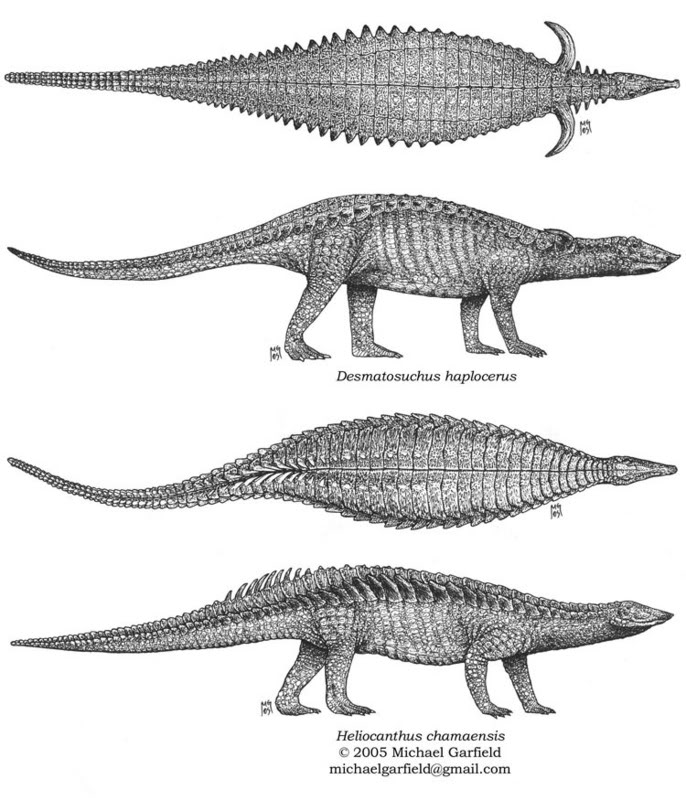
I reconstructed the fossil armor of bizarre pig-crocodiles, two hundred million years dead...

Aetosaurs, July 2005

...and pieced together the awkward gait of extinct flying reptiles from trackways preserved in the mud of an ancient lake.

Pteraichnus, Tate Museum of Casper College

I brought to life numerous prehistoric invertebrates in ink - alternate-reality lobsters with rows of flippers and compound eyes.

Nettapedoura, University of Kansas Department of Geology

Over the three years that I was working daily hours at the museum, I must have drawn at least a hundred thousand scales.

Gekko, University of Kansas Natural History Museum

How I stumbled into live painting is easy to see, in retrospect: those were three years I spent drawing with headphones on, learning to make the cleanest possible lines with the smoothest possible strokes, making immersive and meticulous detail my natural habitat. Training and straining my attention. Doing my best to hold the pen as lightly as possible and push the rate at which a person can stipple in a relaxed and even rhythm. Dot after dot, slowly sculpting the contours, ridges, recesses, tubercles of creatures as long as my thumb, working under a microscope, moving through my whole arm in slow sweeps and hypnotic pointillist pecking.

The living pulse of this work is trance-inducing, tunneling through boredom into exultation. Hunched and squinting, I felt connected to the ocean of nameless monks whose gilded script illuminates our ancient sacred manuscripts. And there was never any doubt for me that I was working in a church - a temple to the natural world, complete with byzantine catacombs of holy relics, shelf after shelf of preserved creatures from all over the world, soaking in alcohol jars.

But then, I was probably the only one having such thoughts. I was the contract artist in a hall of scholars and their graduate disciples, a hundred others who would probably have balked at the notion of science as a religious institution. (Kansas is, after all, the epicenter of a fierce debate between Evolutionary Biology and the so-called science of Intelligent Design. It's a tender topic.) Not a grad student, not a field researcher, not an official employee, I worked as someone whose dreams of paleontology had evaporated and left me in the alkaline and existential expanse of accidental mercenary illustration.

And so, long before I had ever entertained the notion of live painting, the whole foundation had already been poured. A degree-carrying biologist pretending to be an artist, or an artist pretending to be a biologist? Whether inking frogs in a corner of the herpetology library or staking out easel space to the side of the stage, I can't shake the feelings of being a peripheral animal, living on the fringes. The meditative and monastic quality of my experience as an artist, ritually ornamenting some precious text, has flown from the stone cloisters of the halls of science and landed in the whirling ecstasies of more embodied worship.

While illustrating descriptive papers and field guides in the museum, I used the creative faculties of my right brain to present ideas with fidelity and frugal care. While tracing psychedelic lattices and floral blooms in vivid color at concerts, my left brain remains engaged in executing emergent rules and patterns, the visual genome and evolving geometry of pieces I consider living and breathing artifacts of the evening's energies. The organic metaphors that pervade my identity and work, my doing and being, point to the deep structures of my ecological education - while the creative yearning and the commitment to exact visions are the signature of a poetry that runs through my life in settings hushed or boisterous, scholarly or celebratory.

With all of this in mind, my inability to paint (according to my definition) makes little difference to my identity as a naturalist-artist-monk, exploring the strange fauna of the subtle energy worlds conducted by heaving bass and dancing throngs. Plate by plate, I'm assembling a new field guide: a field guide to living jewelry, the bizarre beauties of a mind just on the other side of this one.

2007 12 14, Trilogy Lounge

2007 12 19, Trilogy Lounge

2008 01 29, Avalon Ballroom

Whenever I set up my easel and pull out my bundle of paint markers, I remember one passage in particular: Aldous Huxley's introduction to his essay, "Heaven and Hell." Before my work in the museum, before I recognized the sacred responsibility of the artist, this passage fell through my eyes and down into my deepest reaches - rippling outward until now, finally, I hear it and know who I am:

"Like the earth of a hundred years ago, our mind still has its darkest Africas, its unmapped Borneos and Amazonian basins. In relation to the fauna of these regions we are not yet zoologists, we are mere naturalists and collectors of specimens. The fact is unfortunate; but we have to accept it, we have to make the best of it. However lowly, the work of the collector must be done, before we can proceed to the higher scientific tasks of classification, analysis, experiment, and theory making.

Like the giraffe and the duck-billed platypus, the creatures inhabiting these remoter regions of the mind are exceedingly improbable. Nevertheless they exist, they are facts of observation; and as such, they cannot be ignored by anyone who is honestly trying to understand the world in which he lives.

It is difficult, it is all but impossible, to speak of mental events except in similes drawn from the more familiar universe of material things. If I have made use of geographical and zoological metaphors, it is not wantonly, out of a mere addiction to picturesque language. It is because such metaphors express very forcibly the essential otherness of the mind's far continents, the complete autonomy and self-sufficiency of their inhabitants. A man consists of what I may call an Old Wold of personal consciousness and, beyond a dividing sea, a series of New Worlds - the not too distant Virginias and Carolinas of the personal subconscious and the vegetative soul; the Far West of the collective unconscious, with its flora of symbols, its tribes of aboriginal archetypes; and, across another, vaster ocean, at the antipodes of everyday consciousness, the world of Visionary Experience.

If you go to New South Wales, you will see marsupials hopping about the countryside. And if you go to the antipodes of the conscious mind, you will encounter all sorts of creatures at least as odd as kangaroos. You do not invent these creatures any more than you invent marsupials. They live their own lives in complete independence. A man cannot control them. All he can do is go to the mental equivalent of Australia and look around him."


So that's what I do.

(Written for iggli.com.)

25 March 2008

Painting While Dancing, Part 2: How I Got Into This

Live painting was a curiosity to me, bizarre and insignificant, until last summer, when I finally got to see it actually happen. I had just moved to Boulder from Lawrence, Kansas, where I had been working as a scientific illustrator. Colorado seemed fertile with opportunity, but I was crazy from coasting on my last few hundred dollars while finishing an online degree program and recovering from what may or may not have been the flaming crash of a three-year relationship. I was teetering like a drunken meadowlark on the fencepost between manic exuberance and a panic attack, when my buddies from Lawrence drove up and took me out to the Red Rocks Amphitheatre to catch Sound Tribe Sector 9 (STS9) in concert.

STS9 is the flagship of a recent musical movement called "livetronica," an integration of traditional band instruments with electronic music elements, manipulated as it is happening, on stage. Although artists had been playing around with "live PA" set-ups for years, a full marriage of traditional and emerging technologies only happened a few years ago, when laptop music production software like Ableton Live suddenly made it possible for artists to do all of their soundsculpting in realtime, while recording, under the heat of stage lights. Live turned the laptop computer into a legitimate instrument, and one of the first bands to capitalize on this was Sound Tribe, for which computers perfectly complimented their already-quasi-electronic breakbeat drumming and trance-inducing guitar patterns. (You can find features on their use of computers in concert here and here.)

But that's all pretext for me to explain how the band's reputation for innovative syntheses led them into partnerships with other performance artists, to augment their already-dazzling concerts. The most famous of these is Kris Davidson, a painter whose works have morphed over time from pretty but somewhat prosaic geometrical diagrams:


...into vivid, layered, and organic dripping scapes reminiscent of natural history illustrations and mycelial microscopy:


The point is that Kris D was painting with STS9 when I saw them at Red Rocks last September. And for the first time in my memory, I got to watch someone paint and dance at the same time. I showed up for the second night of a two-night run, so the evening began with what looked to me like a finished painting on stage...and then Kris spent the next three hours burying it in washes and strokes that systematically and repeatedly redefined it. What started out looking like a wall of cubes became a sprawling cityscape, then the face of a mechanical goat, then a spray of tribal warpaint. The painting was breathing and dripping, shifting and blooming, while Kris dashed in for a few quick brushstrokes before retreating a few feet to gain some perspective. He bounced back and forth in a wide stance, perched on the stage with the ready tension of a bowhunter and the easy, casual hips and shoulders of a track runner.

There was something playful, almost flippant in his back and forth: the springy rave dancer with eagle discernment swooping in to exact some measured micro motion and then yaw back out into loose-limbed and watchful bouncing. And back and forth in those oscillations all night. It was an exaggeration of the double-moded painter stereotype, juiced into a higher octave by the uptempo beats and epileptic light show. Ah: this is the difference between painting alone at home, and painting on the receiving end of ten thousand intoxicated dancers. The incredible intensity of Red Rocks - literally, built over the bones of indians and dinosaurs, and channeling thousands of watts of sound between two ruddy monoliths that thrust up from the mountainside like heaving whales - that energy was rushing down onto the stage and through that brush into the painting.

While my own ass-shaking had merely bled heat energy into the mountain air, Kris D funneled that same vibe into a haunting and mysterious work of art:


Here was someone who wasn't merely doodling in class, or cooped up at home with his canvases and cats. Here was someone who had managed to shine, to really shine, in front of thousands of people, without being a member of the band - a rockstar painter who musicians request to goof off with them on stage. Here was someone who got to play pro at some of the best parties in the country and had found an audience for his work that studio artists can scarcely imagine. Here was someone who made his living by painting while dancing.

And that's when I started taking live painting seriously.

(Written for iggli.com)

15 March 2008

Painting While Dancing, Part 1: Hello Wednesdays

Every Wednesday night around 9 pm, I drive out to the Trilogy Wine Bar here in Boulder, Colorado, where my friends Jantsen and Alala have a weekly DJing residency. Together, and with a rotating crew of talented guests, they pack the evening with a variety of electronic subgenres.

As little as a year ago, what they do would have sounded like some kind of alien language to me: dubstep, breakbeat, crunk, glitch, technofunk, whomptronica... And this is music that somehow I've discovered I enjoy - a lot - even though unrelenting doubletime drum breaks over inarticulate gangsta rap and shotgunned with the squealing of deconstructed sound clips is something from which I once would have run screaming.

But no longer. I really enjoy this stuff, now. And I'm sure that a big part of it is that I spend each Wednesday night communing with this music as deeply as possible. I'm not just there to dance; I'm there to paint. It makes a difference, to be part of the show.

Trilogy is split into back and front rooms. The front is a classy, somewhat upscale wine bar and restaurant (a giant triangular wine rack fills the wall behind the bar, in honor of the triplet sisters who own and run the place). Tasteful techno-buddhist paintings on wooden panels accentuate the subtle intensity. Their happy hour is a $5 bottomless glass of wine between 5 pm and 7 pm - an incomparable deal, in this town, and a major boost to their favored reputation. Evenings usually feature some DJ tucked away into one of the corners on a mobile PA system, playing the music that wine-drunk club girls in shiny heels invariably grind to - good for dancing, but typically unremarkable.

A tight squeeze past the couples lining the bar along the North wall and down a narrow hallway brings guests to the back room, which is a totally different creature altogether. Exposed black rafter beams strung with a dozen different brands of Christmas lights hang high over the grimy concrete floor. Soft wall lighting casts long low shadows on the navy walls. A liquor bar, the mirror image of its sister on the other side of the kitchen, sprawls dozens of bottles in front of a smudged mirror. Giant red drapes hang between two fake potted trees on the stage, which is normally a mess of unused stage monitors and snaking cables.

This is unequivocally the best small venue in Boulder. Any band that draws more than fifty and less than three hundred people calls Trilogy its home away from home (and it's popular with some acts that draw far more, on nights when the party spills out into the front room and a video feed is projected on the wall for a second-class audience). The sisters are well-regarded and the notoriously feisty security staff is actually pretty nice, once they get to know you. Bartenders are smiling and loose with the drinks, and the water cooler by the door only occasionally runs dry.

But Trilogy's real claim to fame is its sound system: A moat of subwoofers arranged beneath two massive, monolithic speakers that hang from the ceiling like landing spacecraft frozen in flight. Halfway down the South wall is a mixing board with more knobs than could ever be employed by any band capable of fitting on stage, operated by soundmen made half deaf and half drunk from the power of the equipment. It's a rig capable of unleashing a tsunami of sound and lighting up venues ten times the size of Trilogy. (Thankfully they never run it at full volume, but some of the engineers are obviously more deaf than others. Conversations don't come easily at Trilogy.)

And so. Every Wednesday night, I trundle out into the evening, park along the painted brick walls next to the alley side door, and tote my easel and materials inside to render the night and its noises in paint. This is my job. I work here. Painting while dancing.

---
For upcoming entries in this series, I'll share some of the impressions and the inner process of live painting, as well as recount specific experiences and offer photographic play-by-plays of select paintings as they unfolded over the course of an evening. Stay tuned!

(Written for iggli.com)