Michael Garfield's Love Without End Tour Newsletter: Trilogy
Showing posts with label Trilogy. Show all posts

16 April 2008

Painting While Dancing, Part 4: The Danger of Creativity

Icarus Falling, by Paul Ambroise Stoldtz, 1743

Painting is dangerous.

We don't typically think of painting as dangerous, because we imagine the landscape print in our motel room to have emerged uncomplicatedly from the sweatless brow of some middle-aged homebody with a neat row of clean brushes and a comfortable desk chair. We are the children of Late Capitalism, recognizing product over process. Our physicists are busy looking not for fundamental relationships in the universe, but fundamental particles. We seem not to really grasp the wisdom in statements like, "Happiness is a journey, not a destination." Machines build things for us.

Through clever modern chemistry, being an artist is almost totally non-toxic. You don't even have to get your hands dirty; just use an electronic stylus and tablet, and you can do more with pixels than you ever could have with messier media. And you can do it sitting down.

Even the treacherous borderlands of the mind have been neutered, packaged, labeled, and thus contained. Psychedelia is trite. Been there, done that - our chain retailers advertise with swirling floral blooms and rippling waves of color with an otherworldly richness that puts every Boomer album cover to shame.

Maybe acid did break our parents' chromosomes...or maybe we, like the kids of those Brazilian shamans, have just been innoculated to these deeper weirdnesses by growing up inside of them. Maybe consumer culture just gives us too much to experience, and we've grown even thicker shades to wear as we parade into the Light.

Aliens, angels, ascended masters? Oh yeah, my buddy channels them. Bilocation? I did that, once. We're living in a world that is rending the minds of our parents to tatters, and it's No Big Deal. The extraordinary is, like, so totally ordinary.

But I don't blame any of us for blinding ourselves to the incredible intensity of our age. After all, we're dealing with what Rudolf Otto called the Mysterium Tremendum - the deep unknown at the heart of the world that is so beyond our ken that we could not survive the knowledge. We cower from the face of God for good reason: that creative Source is a burning brightness of which fire is only a cool, pale imitation. History can be read as the story of one daring soul after another throwing itself into the flame, hoping to capture a spark. Our lineage is one of suicide missions, artists and scientists sacrificing themselves for the greater knowledge and experience of the collective.

I believe that the danger of creativity never really went away - it just moved, leaving a sediment of the once-extraordinary behind as it rolled outward like cooling lava into the sea. We live on what was once the boiling coitus of elements - now the terra firma, solid and predictable terrain. Genius and Madness are neighbors because they move fast enough to stay ahead of everyone else, snapping up beachfront property as fast as it is made. (Madness just builds a slightly shoddier house, slightly closer to the tide.) And playing around on the edges is inherently dangerous. In any form, creativity challenges preconceptions, digests conventions, and throws us to burn and drown in the intensely unfamiliar. It changes who we are. "Being creative" is agreeing to an adventure from which nobody has ever, ever returned.

The deep blue pigment bygone painters used for sea and sky was cobalt - it drove them insane with chemical poisoning. Nature photographers have a bad habit of being eaten by wild animals or falling off of cliffs. The most gifted musicians seem especially likely to drown or overdose. It's a common myth across ancient cultures from Africa to Athens that the best artists inherit their talent through deals with water spirits - deals eventually repaid with blood.

(For more on this mysterious phenomenon, I encourage you to read up on the Saturn Return and the 27 Club.)

The Muse - actually an entire coterie of entities that the Greeks held responsible for inspiring every creative act - is a lunar, feminine archetype. The muses were water nymphs, legendary for blinding those arrogant enough to challenge them.

Honest artists admit that they can claim no ownership of their creative work - that it emerges through them, and not from them. And like the biological creative passion of our sexual inheritance, artistic creativity drives us into all kinds of self-destructive recklessness in order to satisfy its own expansive urge. The Muse does not care about you, except as a means to an end. The island on which we perch our traditions is literally built from the bones of artists and scientists.

I think about this a lot, when painting at concerts in front of a heart-rattling beam of sound. I may not have to worry about carcinogenic paints devouring my brain, but that doesn't stop me from feeling like I make my living like a deep sea creature on periphery of a hydrothermal vent, somehow surviving on the narrow ledge between crushing pressure and unbelievable heat, thriving off the rich intersection of extremes. Those benthic creatures lay root at the sweetspot where the ocean carries sustenance directly into their blood - and I plant myself right where a wall of tidal music energy is sieved through my energetic body into crystalline patterns of paint. These images are the love child of the audience's and performers' energies feeding back over a massive electrified circuit, leaving cross-sectional deposits in opaque pigment on a black board - a kind of spectrograph of the evening's collective resonance, deformed and amplified by the matrix of my interpretation.

And this is matter-of-fact science. Chemist Ilya Prigogine won a Nobel Prize for his theory of dissipative structures - the gist of which is that order emerges when so much energy flows through a system that it must reorganize into a higher level of complexity. If it can't keep up with the surge, it is totally destroyed.

Necessity is the mother of invention, just as whirlpools form because the river's current is constrained by the lay of the riverbed. Life is the floret that pushes forth from the equal and opposite vectors of structure and chaos. And so, like Robert Johnson (a member of the 27 Club), I find the soul of my artwork at the crossroads. That's about as deep a truth as I have ever known: that creativity lives in between things, balanced on the head of a pin, spilling from the broken crust of opposing forces.

Putting in my earplugs comes with a sense of frontier glee akin to what I imagine a welder feels when lowering the mask: the pride of having to wear protective equipment so I can play on the turbulent edge of knowing. I didn't think to bring any on my first night out painting, and my ears rang afterward for an entire day. Working on fine art in a crowd of hundreds of drunk dancers requires a special awareness of the space around me, should any teetering reveler pitch over into my easel or elbows. Keeping a dance party schedule means getting to sleep at hours that can't be good for my health. After five consecutive nights of painting, my legs begged for days to wobble out from beneath me.

And even in this supposedly enlightened age, I still have to work in a cloud of noxious fumes if I want to use gold or silver paint. (It's funny: When I was a child, I acted in a public service announcement declaring the dangers of huffing paint. I was the "bad kid" who didn't learn his lesson from the hospitalization of his friends...and now here I am huffing paint every week, only barely against my will.) My burning nostrils connect me to every artist who ever chose beauty over practicality.

I like to think that this job is somehow a mythological gauntlet or trial, that the frightful intensity is a door to greatness. Surely, these four-hour performance painting sessions are growing more muscle in my legs, cultivating my ability to improvise and listen, and teaching me how to conduct myself like a professional. Maybe one of these days I'll come out of the kiln with the strength and coherence that can only be found in fire. Maybe this is just what I need, in a culture that has abandoned its rites of passage.

In the meantime, however, I'm glad that performance painting doesn't require me to dive any deeper into the creative maelstrom than I already do. Sustainable artistry requires compromise, comfort, and care. It demands that artists be responsible enough to keep a little distance from the turbulent shores of the Godhead. Get too close and you'll be consumed, erasing any further gifts you might have transmitted. If you care at all about keeping yourself alive and sane for long enough to do something more than a single incandescent opus, remember that the womb has teeth. The sun is on fire. You can't breathe underwater. And painting is dangerous.

"What gives light, must endure burning."
- Viktor Frankl

(Written for iggli.com)

28 March 2008

Painting While Dancing, Part 3: Stray Dog In The Temple

Sometimes I feel like grabbing someone and pleading with them to please remind me what I'm doing, pretending to be a painter. It's a term I can only offer with the following (usually unuttered) disclaimer:

I don't know how to use a paint brush. I am intimidated by the notion of mixing my own colors. In fact, I have no formal education in art of any kind - and so I use paint markers on foam board. I borrowed an easel to do my first show.

It's one of the enduring ironies of my existence, that I define myself by my work but the best descriptor for what I do is something I don't consider myself to be. There's more than a little imposter's guilt in me when I carry my easel into the Trilogy Wine Bar every Wednesday night to be a painter, like I accidentally received an invitation to the party and I don't have the guts to admit I don't belong there. Like I'm a wild bird that snuck into the aviary to live off the free food. Like I'm a fox pretending to be a lapdog.

But I might make up for my lack of disciplined training with twenty years' experience of doodling in class, at parties, on planes, and in my sleep (although those images rarely survive the morning). A childhood of dinosaurs and aliens carried me into a scientific illustration course in college, from which I was hired directly to draw plates of frogs, snakes, and lizards for species descriptions at the University of Kansas Natural History Museum.
Frogs, University of Kansas Natural History Museum

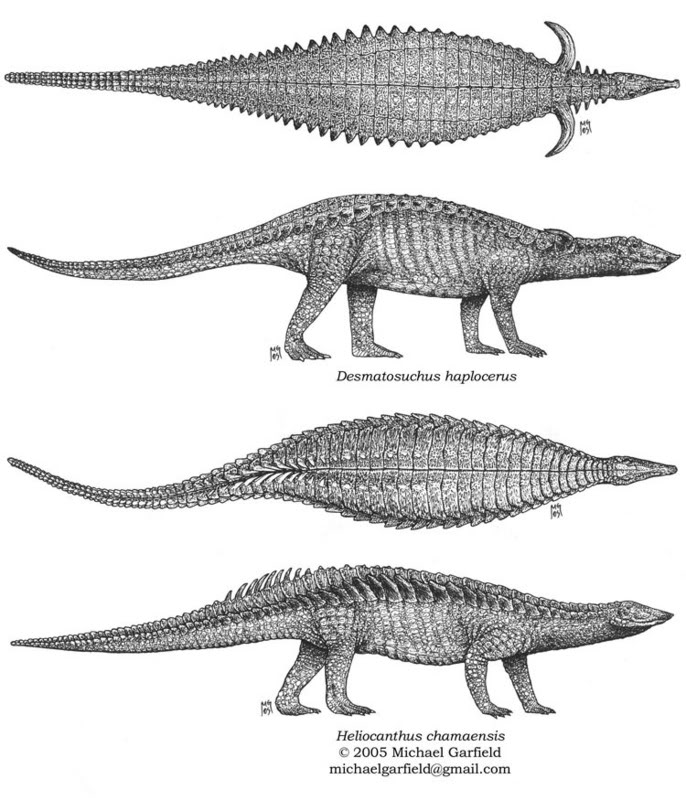
I reconstructed the fossil armor of bizarre pig-crocodiles, two hundred million years dead...

Aetosaurs, July 2005

...and pieced together the awkward gait of extinct flying reptiles from trackways preserved in the mud of an ancient lake.

Pteraichnus, Tate Museum of Casper College

I brought to life numerous prehistoric invertebrates in ink - alternate-reality lobsters with rows of flippers and compound eyes.

Nettapedoura, University of Kansas Department of Geology

Over the three years that I was working daily hours at the museum, I must have drawn at least a hundred thousand scales.

Gekko, University of Kansas Natural History Museum

How I stumbled into live painting is easy to see, in retrospect: those were three years I spent drawing with headphones on, learning to make the cleanest possible lines with the smoothest possible strokes, making immersive and meticulous detail my natural habitat. Training and straining my attention. Doing my best to hold the pen as lightly as possible and push the rate at which a person can stipple in a relaxed and even rhythm. Dot after dot, slowly sculpting the contours, ridges, recesses, tubercles of creatures as long as my thumb, working under a microscope, moving through my whole arm in slow sweeps and hypnotic pointillist pecking.

The living pulse of this work is trance-inducing, tunneling through boredom into exultation. Hunched and squinting, I felt connected to the ocean of nameless monks whose gilded script illuminates our ancient sacred manuscripts. And there was never any doubt for me that I was working in a church - a temple to the natural world, complete with byzantine catacombs of holy relics, shelf after shelf of preserved creatures from all over the world, soaking in alcohol jars.

But then, I was probably the only one having such thoughts. I was the contract artist in a hall of scholars and their graduate disciples, a hundred others who would probably have balked at the notion of science as a religious institution. (Kansas is, after all, the epicenter of a fierce debate between Evolutionary Biology and the so-called science of Intelligent Design. It's a tender topic.) Not a grad student, not a field researcher, not an official employee, I worked as someone whose dreams of paleontology had evaporated and left me in the alkaline and existential expanse of accidental mercenary illustration.

And so, long before I had ever entertained the notion of live painting, the whole foundation had already been poured. A degree-carrying biologist pretending to be an artist, or an artist pretending to be a biologist? Whether inking frogs in a corner of the herpetology library or staking out easel space to the side of the stage, I can't shake the feelings of being a peripheral animal, living on the fringes. The meditative and monastic quality of my experience as an artist, ritually ornamenting some precious text, has flown from the stone cloisters of the halls of science and landed in the whirling ecstasies of more embodied worship.

While illustrating descriptive papers and field guides in the museum, I used the creative faculties of my right brain to present ideas with fidelity and frugal care. While tracing psychedelic lattices and floral blooms in vivid color at concerts, my left brain remains engaged in executing emergent rules and patterns, the visual genome and evolving geometry of pieces I consider living and breathing artifacts of the evening's energies. The organic metaphors that pervade my identity and work, my doing and being, point to the deep structures of my ecological education - while the creative yearning and the commitment to exact visions are the signature of a poetry that runs through my life in settings hushed or boisterous, scholarly or celebratory.

With all of this in mind, my inability to paint (according to my definition) makes little difference to my identity as a naturalist-artist-monk, exploring the strange fauna of the subtle energy worlds conducted by heaving bass and dancing throngs. Plate by plate, I'm assembling a new field guide: a field guide to living jewelry, the bizarre beauties of a mind just on the other side of this one.

2007 12 14, Trilogy Lounge

2007 12 19, Trilogy Lounge

2008 01 29, Avalon Ballroom

Whenever I set up my easel and pull out my bundle of paint markers, I remember one passage in particular: Aldous Huxley's introduction to his essay, "Heaven and Hell." Before my work in the museum, before I recognized the sacred responsibility of the artist, this passage fell through my eyes and down into my deepest reaches - rippling outward until now, finally, I hear it and know who I am:

"Like the earth of a hundred years ago, our mind still has its darkest Africas, its unmapped Borneos and Amazonian basins. In relation to the fauna of these regions we are not yet zoologists, we are mere naturalists and collectors of specimens. The fact is unfortunate; but we have to accept it, we have to make the best of it. However lowly, the work of the collector must be done, before we can proceed to the higher scientific tasks of classification, analysis, experiment, and theory making.

Like the giraffe and the duck-billed platypus, the creatures inhabiting these remoter regions of the mind are exceedingly improbable. Nevertheless they exist, they are facts of observation; and as such, they cannot be ignored by anyone who is honestly trying to understand the world in which he lives.

It is difficult, it is all but impossible, to speak of mental events except in similes drawn from the more familiar universe of material things. If I have made use of geographical and zoological metaphors, it is not wantonly, out of a mere addiction to picturesque language. It is because such metaphors express very forcibly the essential otherness of the mind's far continents, the complete autonomy and self-sufficiency of their inhabitants. A man consists of what I may call an Old Wold of personal consciousness and, beyond a dividing sea, a series of New Worlds - the not too distant Virginias and Carolinas of the personal subconscious and the vegetative soul; the Far West of the collective unconscious, with its flora of symbols, its tribes of aboriginal archetypes; and, across another, vaster ocean, at the antipodes of everyday consciousness, the world of Visionary Experience.

If you go to New South Wales, you will see marsupials hopping about the countryside. And if you go to the antipodes of the conscious mind, you will encounter all sorts of creatures at least as odd as kangaroos. You do not invent these creatures any more than you invent marsupials. They live their own lives in complete independence. A man cannot control them. All he can do is go to the mental equivalent of Australia and look around him."


So that's what I do.

(Written for iggli.com.)

15 March 2008

Painting While Dancing, Part 1: Hello Wednesdays

Every Wednesday night around 9 pm, I drive out to the Trilogy Wine Bar here in Boulder, Colorado, where my friends Jantsen and Alala have a weekly DJing residency. Together, and with a rotating crew of talented guests, they pack the evening with a variety of electronic subgenres.

As little as a year ago, what they do would have sounded like some kind of alien language to me: dubstep, breakbeat, crunk, glitch, technofunk, whomptronica... And this is music that somehow I've discovered I enjoy - a lot - even though unrelenting doubletime drum breaks over inarticulate gangsta rap and shotgunned with the squealing of deconstructed sound clips is something from which I once would have run screaming.

But no longer. I really enjoy this stuff, now. And I'm sure that a big part of it is that I spend each Wednesday night communing with this music as deeply as possible. I'm not just there to dance; I'm there to paint. It makes a difference, to be part of the show.

Trilogy is split into back and front rooms. The front is a classy, somewhat upscale wine bar and restaurant (a giant triangular wine rack fills the wall behind the bar, in honor of the triplet sisters who own and run the place). Tasteful techno-buddhist paintings on wooden panels accentuate the subtle intensity. Their happy hour is a $5 bottomless glass of wine between 5 pm and 7 pm - an incomparable deal, in this town, and a major boost to their favored reputation. Evenings usually feature some DJ tucked away into one of the corners on a mobile PA system, playing the music that wine-drunk club girls in shiny heels invariably grind to - good for dancing, but typically unremarkable.

A tight squeeze past the couples lining the bar along the North wall and down a narrow hallway brings guests to the back room, which is a totally different creature altogether. Exposed black rafter beams strung with a dozen different brands of Christmas lights hang high over the grimy concrete floor. Soft wall lighting casts long low shadows on the navy walls. A liquor bar, the mirror image of its sister on the other side of the kitchen, sprawls dozens of bottles in front of a smudged mirror. Giant red drapes hang between two fake potted trees on the stage, which is normally a mess of unused stage monitors and snaking cables.

This is unequivocally the best small venue in Boulder. Any band that draws more than fifty and less than three hundred people calls Trilogy its home away from home (and it's popular with some acts that draw far more, on nights when the party spills out into the front room and a video feed is projected on the wall for a second-class audience). The sisters are well-regarded and the notoriously feisty security staff is actually pretty nice, once they get to know you. Bartenders are smiling and loose with the drinks, and the water cooler by the door only occasionally runs dry.

But Trilogy's real claim to fame is its sound system: A moat of subwoofers arranged beneath two massive, monolithic speakers that hang from the ceiling like landing spacecraft frozen in flight. Halfway down the South wall is a mixing board with more knobs than could ever be employed by any band capable of fitting on stage, operated by soundmen made half deaf and half drunk from the power of the equipment. It's a rig capable of unleashing a tsunami of sound and lighting up venues ten times the size of Trilogy. (Thankfully they never run it at full volume, but some of the engineers are obviously more deaf than others. Conversations don't come easily at Trilogy.)

And so. Every Wednesday night, I trundle out into the evening, park along the painted brick walls next to the alley side door, and tote my easel and materials inside to render the night and its noises in paint. This is my job. I work here. Painting while dancing.

---
For upcoming entries in this series, I'll share some of the impressions and the inner process of live painting, as well as recount specific experiences and offer photographic play-by-plays of select paintings as they unfolded over the course of an evening. Stay tuned!

(Written for iggli.com)

02 September 2007

Visionary Instruments: The Reactable

This is the first entry in a series I'll be doing on instruments that are revolutionizing the way we make - and understand - music. I was inspired to do this column by my introduction to one of the most inspiring inventions of any kind that I have ever seen, a wonderful new music performance device (it bends the definition of "instrument") called the reactable.

(I saw it at a Björk concert in April - leave it to her to debut musical technology that makes people feel like they've been cryogenically frozen for a hundred years!)

Devised by the Interactive Sonic Systems Team at the Universitat Pompeu Fabra in Barcelona, the reactable is a totally novel musical control interface driven not by technology, but by a vision of a new way to make noise. The reactable homepage declares the intent behind it all - to make an instrument that is:

- collaborative: several performers (locally or remotely)
- intuitive: zero manual, zero instructions
- sonically challenging and interesting
- learnable and masterable (even for children)
- suitable for novices (installations) and advanced electronic musicians (concerts)

No small task, and yet these people have pulled the rabbit out of the hat. Here are some demonstrations:


Now that you have an inkling as to how this works, here's an example of the reactable in a live environment, on the Björk tour for which none of us were even remotely prepared (don't skip ahead, but the reactable is nicely featured in a segment starting at 4:36):


So yeah. Go visit the team's reactable media page for a score of additional videos that boggle the mind (as well as hi-res versions of those above, so you can feel even more futuristic - and even an amusing clip of Bob Moog playing an early protoype).

What tickles me the most is that, not only did the Interactive Sonic Systems team start with an idea and then bring the technology up to the level of that idea (which, as far as I'm concerned, is how it should be done: leading with intention), but that they left enough clues that you can build your own! All of their publications from the inception of the idea can be found here. The open-source code they wrote to control the visual recognition elements can be found here. A few pieces are still proprietary, but there's enough information scattered around in user groups that some buddies of mine, members of the Boulder, CO visionary art collective Motion For Alliance, built their own prototype. They brought it out for its debut last night at the Trilogy Wine Bar in Boulder - and, of course, it blew everybody away. Here's a video of their "bootleg" reactable:


They had four people working this thing last night, simultaneously - a vivid demonstration of the new realm of collaborative improvisation this thing opens up for us. (I'll try and post a video from the concert here soon.) Pretty soon, Fisher Price will be making one, they'll be selling them at Wal-Mart, and cafés will be spilling over with acoustic guitar and reactable duos...at which point, musicianship will be a whole new game. Spain, I tip my hat to you.