Michael Garfield's Love Without End Tour Newsletter: integral
Showing posts with label integral. Show all posts

20 November 2013

Annual Art Sale | Featured Artist on Integral Life | New Collab Painting | New Article on High Existence | Frank Heiss Remix | Sonic Bloom 2013 Panel | ISO Booking Agent

"Human beings must have an epic, a sublime account of how the world was created and how humanity became part of it.  Religious epics satisfy another primal need. They confirm we are part of something greater than ourselves.  The way to achieve our epic that unites human spirituality, instead of cleave it, it is to compose it from the best empirical knowledge that science and history can provide."
– E.O. Wilson

I have so much to tell you.  I'm sure you have so much to say.  I don't even know where to start having that kind of authentic exchange via this newsletter.  Feel free to write to me – I'd love to know what Great Work consumes you, these days, and if I could contribute to it.  And of course, more goes on in my life than I have space for in this newsletter – so feel free to follow my thoughts and recommended reading over twitter, instagram, facebook, tumblr, or youtube.

For now:

Annual Live Art Sale

Last week I lost a shoulder bag containing about 150 of my prints and a nice presentation book, as well as electrical cords for live painting. In other words, it's Holiday Art Sale time! Take 30% off the listed price on all original paintings, and pieces priced on my (seven-year-old) hourly wage are now stupidly cheap (like the only live painting ever made at NASA, for example).  I'll accept monthly payments as low as $100 if you want a piece but have to pay for it gradually.

This isn't just good news for high rollin' gangstas who want to line their cribs with original art - you're also in luck if you want inexpensive prints, pins, merch, etc. for your loved ones (or enemies - good for you!) this year. More details on the FB event page.

Featured Artist on IntegralLife.com!

Big thanks to Integral Life for featuring my art this month! Here is a community that really knows how to THINK about stuff...it's an honor.  I've been an admirer of Ken Wilber's integral philosophy for a whole decade, and am delighted to give back by sharing my art and ideas.

Check out the great gallery they put together with academic commentary and a new artist's statement...

The Encroaching Tides
(a collab with Tourmaline Todd)

My friend "Tourmaline" Todd Shepherd is a fixture in the Austin, Texas live art scene and familiar to admirers all over the country for his cool work on hat racks, vinyl figurines, and all kinds of other unusual media.  I think his futuristic, spacey style and mine dovetailed together quite nicely on our first-ever studio collaboration...

New Article on HighExistence.com

We humans have a bad habit of assuming we're special.  But science teaches us over and over that we're not.  Here is my latest morsel of food for thought, on High Existence, about how to strike a balance between grandeur and humility.  A teaser:

The accepted story of physics right now is that we live on a miraculous, impossible planet where solar eclipses can happen because the Moon is the same apparent size in the sky as the Sun, and where our orbital wobble, the Precession of the Equinoxes, takes exactly as many years as we are light years from the center of the galaxy – which just so happens to be a cozy intermediate zone where core radiation won’t melt DNA and the frigid depths of space don’t render chemistry a moot point. (And all chemistry is biochemistry, it seems .) Above it all, we live at a special moment in the life cycle of our star, a narrow window before it swells to consume the entire Earth. Statistically, life is impossible, but if it’s possible anywhere, it’s here – in this impossibly convenient place.

This is the Goldilocks Hypothesis, and it’s junk. If we’re going to take the Copernican Revolution all the way, let’s go there: we are perfectly adapted for this place because life is always adapted to its surroundings. All that hawking radiation from the supermassive black hole at the galactic center might boil carbon-based life, but as NASA’s astrobiologists are quick to remind us there’s no reason to suppose that heavier elements haven’t grown metal minds, evolving at breakneck pace in the roiling creation, linked through the instantaneous communication of frictionless superfluid field dynamics, vortices within vortices.

Sonic Bloom 2013 Panel Discussion

The third annual Sonic Bloom Festival all-star panel discussion was our most diverse and impassioned yet. In a conversation moderated by Solpurpose.com editor-in-chief Michael Garfield, festival director Jamie Janover, community builder Mark Heley, bass producer Lux Moderna, astrologer Ver Dar Luz, dream interpreter Jonathan Zap, healer Alaya Love, video blogger Jordan Pearce, and his friend Ray all gave real talk on life, death, and categories beyond and between. This hour is the fruit of a truly transformational festival - potent, raw, and deep...

Remixed by Frank Heiss

I recently uploaded an archive of my guitar loops for producers to play with – little did I know that living legend Frank Heiss would take advantage of it for his next album!  But he did.  Now you can listen to his strange and beautiful remix, "The Good, The True and the Beautiful," the closer for his awesome full-length release.  You might recognize some of it from various instrumental improvisations on last year's Love Scenes & Field Recordings – as well as the artwork, by my homie Michael Divine.

In Search Of A Booking Agent

This week in the Ask-And-Ye-Shall-Receive Department:  I've been booking my own gigs for the last six years (full history here) and as successful as it may seem I've been with that, I can't keep making all of this art, music, and writing AND book 70+ shows a year.  It's hard work that I have to outsource if I'm going to take my career to the next level...and I'm ready to make friends in some different scenes.

So if you know people who represent musicians or performing artists, please introduce us!  Anyone who can hook me up with a good booking agent gets my eternal gratitude and a bunch of sweet art.  (Here is my full EPK, to make things a little easier.)

Thanks again for reading, enjoy the art and ideas, and have a beautiful day!

26 August 2010

From Independence To Integration, Part Two

"To learn something new, take the path that you took yesterday."
- John Burroughs

People I meet often ask me what it is I'm doing out on the road – and since my touring combines art, music, and lecturing along with a profound amount of synchronous conversation and spontaneous diversions that don't make sense until days or weeks later...well, I've had a hard time explaining what exactly I do for a living. But here it is:

I'm developing my intuition to navigate an accelerating and increasingly complex world – and in the process, inspire people to find their purpose in the wondrous cosmic order so that they can bring their love and effort into alignment. I'm learning to be in the right place at the right time, all the time...to be useful to the world as only I can be, continuously.

There's still a gap between the guidance I get and my decision to act upon it – a gap I'm learning to narrow until choice disappears and I am always doing and being what I must. There is a profound satisfaction that comes from this, and it seems like more and more of what I do is about helping people find the insights they need to figure this out for themselves.

Because I am the agent of a future in which everyone is the loving participant in a harmonious greater whole; when everyone is connected to both the dignity and humility of their lives, here; when we all know why we matter and are so blown open to wonder that our greatness can't possibly go to our heads.

Last week, the Perseid meteor shower lit up the skies of North America with streaking fireballs. Here are the latest tracers burning off from my own meteoric descent – into the truth of my human nature, my own reconciliation with body and destiny, as this tour draws to a close and I return home with new eyes and a wider heart...

Lecture Notes (ITC 2010)
2010 07 30 – 08 01 John F. Kennedy University
(Integral Theory Conference 2010)
Prismacolor markers on Bristol paper
11"x17" prints available: $20 + $5 s/h (order)


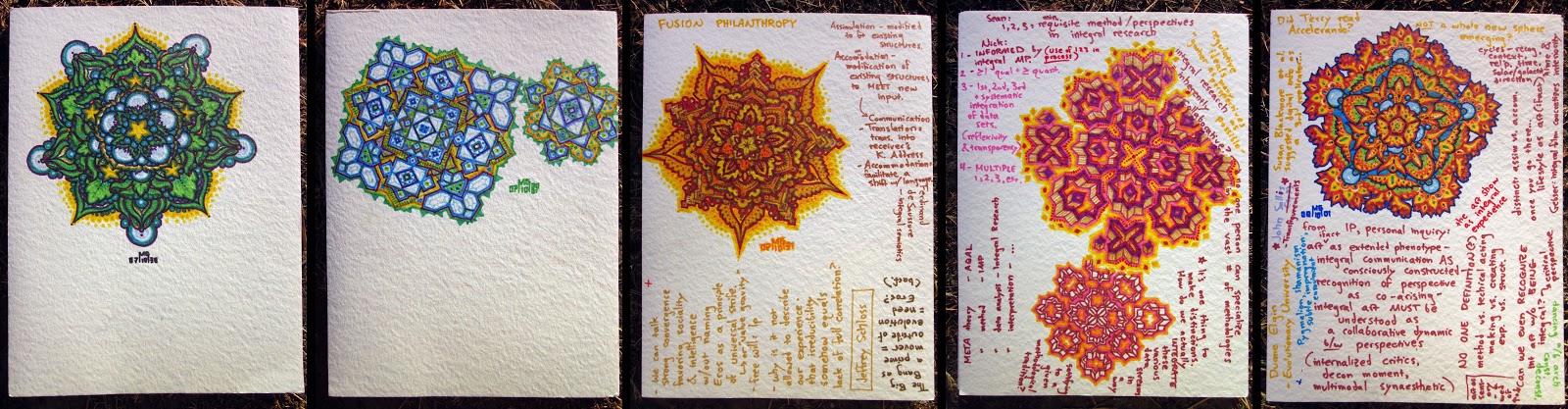
Allow me to geek out for a moment. I haven't doodled in class ince 2005, but I was psyched to have another opportunity to engage this favorite pastime when invited to the second biennial Integral Theory Conference at John F. Kennedy University. All weekend, there were eight tracks of presentations on everything from the neurophysiological correlates of post-rational consciousness, to the woeful state of evolutionary science in the academic integral theory community, to the multiple ecologies perceived by people at different developmental levels, to the role of metatheory in architecture. I was in dork heaven. And consequently, I got to spend some time with my old techniques, good old markers on paper (although both have gotten an upgrade in recent years), starting small and working out from the middle instead of starting big and filling in detail like I can do with the paint markers. What you see above are both original pages and a single-sheet compilation of the weekend's sketches, photo-stitched for print-making convenience.

Custom Name Badges (ITC 2010)

I also had the opportunity to customize the name tags for several other attendees, which is a wonderful exercise in reading a person and doing my best to give strangers some deeply-relevant, intuitively uncanny bling. In fact, customizing badges at another integral conference in 2007 was my first taste of using intuition to create a work of art and check it against the person's response. Made a few people pretty happy with these, which as you know feels really good.

Thanks to Sean Esbjörn-Hargens and Mark Forman for working so hard to organize this conference, and for inviting me to participate in the landmark Integral Art discussion panel...unquestionably the best conversation I've ever had about the future of human creativity.

Bubble Matrix
2010 08 04 Club 6
(Psychedelic Bicycle Ride Visionary Arts Expo)
paint markers on cradled gesso board
original: check price & availability here
11"x17" prints available: $20 + $5 s/h (order)


While in San Francisco a few weeks ago, I was invited to set up an art table across from my boyz and girlz at MAPS for an arts exposition honoring psychedelic art, concert posters, and the like. Stanley Mouse was there (and borrowed a lamp I never got back); DJ Logic was playing in the basement (and was nice enough to stop by my table and chat).

This painting inaugurates my use of fill-them-yourself pens loaded with shimmering blue acrylic to create a semi-transparent layer between patterns. I thought I'd never be able to do this! That this was something restricted to the MFA, we-use-brushes crowd. Apparently not. Admittedly, this one is in the ranks of my rare paintings for which I used a ruler on the first layer (but we're talking about five out of a hundred and ninety, here, so I don't feel too bad about it).

Thanks goes out to Erin Cadigan for organizing the event and having me on board.

Fire From Ice
(before)
(after)
2010 08 06 & 2008 12 14 Rootwire & The Mountain Sun
(Zoogma, Ultraviolet Hippopotamus, Magmablood, Garanta)
paint markers on masonite
original: check price & availability here
11"x17" prints available: $20 + $5 s/h (order)

Once upon a time, I traveled with the band Zoogma on their first tour up to Colorado (my first time as a dedicated tour painter). The results included this timelapse video and the original version of this painting...but after a few years of it sitting around, narrowly avoiding one buyer after another, I figured it was time to take it a little deeper. New technique: paint numerous glowing metallic layers and then smudge them until it looks like dirty money. (Zoom in on the "after" shot for more detail...)

This one goes out to the Zoogma boys, who have gotten so much better over the years...

Cosm Eye
(before)

(after)
2010 08 07 Rootwire, 2009 11 07 Trinumeral Festival,
& 2009 09 10 Boulder Farmer's Market
(Pnuma Trio, M80 Dubstation, Conspirator, Papadosio, EP3, The Malah)
paint markers on masonite
original: check price & availability
here
11"x17" prints available: $20 + $5 s/h (order)


This painting has almost gone through more transformation than I have in the past year. Click on it for a closer look at those translucent structures in the foreground...I definitely want to do more "space squid" type stuff, as these luminous biomechanical patterns – the angelic to H.R. Giger's demonic – are so core to my own mystical experiences I don't know what else to say about it.

This piece is dedicated to Erik Davis, who wrote the best article ever on the Lovecraftian tentacled-space-god meme and its relationship to the dignity and disaster of modernity...

Let It Go
2010 08 06, 07, 08 Rootwire
(roeVy, Freepeoples Frequency, Nala,
The Werks, Papadosio acoustic)
paint markers on masonite
original: check price & availability
here
11"x17" prints available: $20 + $5 s/h (order)


Instructions for finding an awesome new style:
1) Paint something you don't like, then spray a fog of paint over it to make it a background layer;
2) Paint something else you don't like over that, and raise your hands in frustration;
3) Black out half the painting with more spray paint;
4) Add a transparent layer of monochrome intricacy over the whole thing, as if a new universe is fading into this one, pushing the grimy graffiti of mere human creativity into the irrelevant past.

This one reminds me of that uniquely psychedelic bother of ideas coming too quickly to hold onto them – just as you try to focus on one pattern, it becomes the background of the next. You might as well just give up and watch the show...

In fact, I think this is what is happening with our accelerating techno-culture right now, the prophecy of various visionaries like Timothy Leary & Terence McKenna (I've written about this at length) and fictionalized beautifully by Charles Stross' sci-fi masterpiece Accelerando.

Because this painting is the closest I've gotten so far to reproducing that feeling of future shock in a visual form, I dedicate it to Mr. Stross. Keep blowing minds, man.

15 June 2009

Let A Hundred Futures Bloom: A Both/And Survey of Transhumanist Speculation

Mention the world “transhumanism” to most of my friends, and they will assume you mean uploading people into a computer. Transcendence typically connotes an escape from the trappings of this world — from the frailty of our bodies, the evolutionary wiring of our primate psychologies, and our necessary adherence to physical law.

However, the more I learn about the creative flux of our universe, the more the evolutionary process appears to be not about withdrawal, but engagement – not escape, but embrace – not arriving at a final solution, but opening the scope of our questions. Any valid map of evolution is fractal – evermore complex, and always shifting to expose unexplored terrain.

This is why I find it is laughable when we try to arrive at a common vision of the future. For the most part, we still operate on “either/or” software, but we live in a “both/and” universe that seems willing to try anything at least once. “Transhuman” and “posthuman” are less specific classifications than catch-alls for whatever we deem beyond what we are now… and that is a lot.

So when I am in the mood for some armchair futurism, I like to remember the old Chinese adage: “Let a hundred flowers bloom.” Why do we think it will be one way or the other? The future arrives by many roads. Courtesy of some of science fiction’s finest speculative minds, here are a few of my favorites:

...By Elective Surgery & Genetic Engineering

In Greg Egan’s novel Distress, a journalist surveying the gray areas of bioethics interviews an elective autistic — a man who opted to have regions of his brain removed in order to tune out of the emotional spectrum and into the deep synesthetic-associative brilliance of savants. Certainly, most people consider choice a core trait of humanity… but when a person chooses to remove that which many consider indispensable human hardware, is he now more “pre-” than “post-?” Even today, we augment ourselves with artificial limbs and organs (while hastily amputating entire regions of a complex and poorly-understood bio-electric system); and extend our senses and memories with distributed electronic networks (thus increasing our dependence on external infrastructure for what many scientists argue are universal, if mysterious, capacities of “wild-type” Homo sapiens). It all begs the question: are our modifications rendering us more or less than human? Or will this distinction lose its meaning, in a world that challenges our ability to define what “human” even means?

Just a few pages later in Distress, the billionaire owner of a global biotech firm replaces all of his nucleotides with synthetic base pairs as a defense against all known pathogens. Looks human, smells human…but he has spliced himself out of the Kingdom Animalia entirely, forming an unprecedented genetic lineage.

In both cases, we seem bound to shuffle sideways – six of one, half a dozen of the other.

...By Involuntary Implosion

In the 1980s, Greg Bear explored an early version of “computronium” – matter optimized for information-processing – in Blood Music, the story of a biologist who hacks individual human lymphocytes to compute as fast as an entire brain. When he becomes contaminated by the experiment, his own body transforms into a city of sentient beings, each as smart as himself. Eventually, they download his whole self into one of their own — paradoxically running a copy of the entire organism on one of its constituent parts. From there things only get stranger, as the lymphocytes turn to investigate levels of reality too small for macro-humans to observe.

Scenarios such as this are natural extrapolations of Moore’s Law, that now-famous bit about computers regularly halving in size and price. And Moore’s Law is just one example of a larger evolutionary trend: for example, functions once distributed between every member of primitive tribes (the regulatory processes of the social ego, or the formation of a moral code) are now typically internalized and processed by every adult in the modern city. Just as we now recognize the Greek Gods as embodied archetypes correlated with neural subroutines, the redistributive gathering of intelligence from environment to “individual” seems likely to transform the body into a much smarter three cubic feet of flesh than the one we are accustomed to.

...By Nano-Hacking

Then again, there might be systemic constraints to just how far tech will take us. Charles Stross’ Glasshouse offers a rare perspective on the possible consequences of nanotechnology: once we all rely on computers to back ourselves up and store ourselves for interstellar transit, those computers become the targets for a new level of informational warfare. In a world where people can be rebuilt at whim, murder is effectively obsolete.. No one can be killed, but everyone is at constant risk of being hacked. Suddenly you wake up working for the enemy, and loving it. Selective memory erasure programs saturate the network and prevent any further development from crossing communities and achieving universality. History is routinely wiped, so no new wisdom can accrue. Once again, humanity is splintered into countless isolated physical and mental regions, and some of them respond by choosing to eschew high technology entirely, living and dying on the clock of some long-forgotten world.

In other words, what we normally imagine as a linear continuum might instead be a wave of progress that ebbs and flows, a cycle of Light and Dark Ages distributed capriciously through space-time.

...By Hyperdimensional Intervention

The idea that humankind will be “initiated” into a new and higher mode of being by some other race of transcendental entities has been circulating for thousands of years. Perhaps there is a common trajectory for the development of sentient species, and we receive intermittent, minimally-intrusive guidance by those who came before us. It is an idea that has certainly found its way into common sci-fi discourse — be it through Arthur C. Clarke’s 2001 or Stephen Baxter’s Manifold. Were we to take seriously the growing ranks of exopoliticians, exobiologists, and exolinguists, this in fact is happening. Descartes was given his famous plane — practically the emblem of rational modernity — by an angelic vision. Francis Crick (co-discoverer of the double helix) and Kary Mullis (pioneer of the Polymerase Chain Reaction) both admitted to interfacing with LSD when their Nobel Prize-winning finds came to them. Crop circles form overnight in muddy fields with no footprints, bearing strange radiation signatures and seeming to encrypt dense information about the structure of the quantum vacuum and the movement of celestial bodies. This pattern is almost universal among species-changing creative eruptions (or are they irruptions?) throughout history; even Moses had his burning bush. In every instance, these revelations drew our species closer to what we might call transhuman. We’re “getting the message,” but who is doing the talking?

...By Natural Quantum Evolution

One option in particular seems to get short shrift by a community that tends to believe we will lift ourselves up into a posthuman order by our own bootstraps…but if the future even modestly resembles the past, then we cannot neglect the possibility that nature will do the heavy lifting for us. Recent research at UC Berkeley and Washington University has demonstrated that photosynthesis is 95% efficient because it uses quantum computation to retroactively decide upon the best possible electron paths. Johnjoe McFadden at the University of Surrey has suggested that this very same process may have been how life emerged in the first place, and other scientists have noted similar, strangely intelligent mutation responses in lab cultures. Egan’s novel Teranesia runs with this new model of “smart evolution,” suggesting that we may see posthumanity spontaneously self-organize out of the quantum superposition of all possible futures — as if good ideas reach backward in time to organize their necessary histories. Given the uncanny prescience of some sci-fi speculation, this might not be too far from the truth.

All of the Above

As our options increase, humanity — and whatever else might call us their ancestors — will probably continue to take every form available: flesh, metal, and software; post-linguistic and pre-linguistic; evolution by self-mastery and deus ex machina. If it can happen, it probably will. This is the world in which we live, and every step we take into the future makes that increasingly, painfully obvious. Transhumanism, as best as I can define it, is the story of “and.”

(Written for H+ Magazine.)

15 April 2009

YOU'RE The Musician; YOU Make Some Noise!

(continued from part one)

I have been consumed by thoughts regarding the changing role of the artist in our culture. As I started to mention in my previous essay ("The 3-2-1 of Musical Performance"), there are – even in the narrow and unimaginative relationships between contemporary musicians and their audiences – at least three different depths of intimacy, three different lenses through which the rules of performance can be observed. The performer, in recognizing the audience as Impersonal Other (It), Personal Other (You), or Self (I), projects radically different characteristics on the concert environment.
This can be intentional, but usually artists naturally settle into one of these three perspectives and become known for it. (To give you a taste of what I mean, imagine the distinctions between playing to a room full of uninterested strangers, or friends, or family, or alone, or as worship...now imagine taking each of those various perspectives on the same group of people. It's a fantastic exercise in developing fluid perception.)
This is the kind of thing I rattle on about to whomever I can capture in my word-sphere, trying to coax from them new aspects I haven't recognized. I brought this stuff up with my girlfriend the morning after live painting at a huge rave outside of Phoenix. One of their MCs spent most of his airtime asking how many of us were fucked up, and how many of us were really fucked up, and complaining that we weren't making enough noise, and try again, make some fucking noise!

Never mind that as someone more immersed the jam band scene and its hippie-noveau mentality, I can't imagine actually volunteering to announce that I am on drugs. Never mind that I was questioning the musicality of the entire event when I found out that one of the headlining DJs, apparently by playing the same stuff I'd heard in a dubious Scottsdale nightclub the evening before, had been voted #4 in the US (our desiccated monoculture should be evidence enough for the dangers of democracy).

The real sticking point was this:

As a passionate defender of individual autonomy, someone who bristles up when a DJ's robotic vocal sample insists, "I – control you! I – control you!," I'd rather zip my lips in revolt when some obnoxious dude with a microphone tries to play audio-puppeteer. I believe it is the urgent duty of anyone blessed enough to be amplified before a crowd to at least attempt to express some understanding of our common identity. And this guy clearly didn't get it.
My girlfriend, once a symphonic violist for the Topeka Symphony and thus coming from a much more formal tradition of stage-theatre interaction, put it well:
"YOU'RE the musician; YOU make some noise!"

On the one hand, this is exactly the assumption that I as a songwriter would like to challenge. I don't want us all relinquishing our creative agency to whomever The Machine decides is going to be The Next Big Thing. In an age when we can all produce our own books/video/music/fine art/theater, I think it's time for us to reclaim our inspiration from centralized corporate governance.

At the same time, even as an artist I prefer to let the guy on stage take the reigns for a little while. Yelling at your audience for not giving you enough applause is a tragic misunderstanding of the postmodern argument that the critic co-creates the artwork. It's an abdication of your personal responsibility to melt our fucking faces off. And it's a waste of our time – we came to get down, not to coddle your bravado. Less talk, more rock.

Of course, there are awesome exceptions to these traditional polarities – like John Cage's piece 4'33", for which a blank score is placed on the stand and the pianist (or any other musicians) just sits there while the audience starts to squirm. After a minute or two, people are coughing, shifting in their seats, sighing...and all of these random noises make up the actual performance, by an unwitting orchestra.

Cage, a postmodern philosopher and mystic if there ever was one, was making a point: pulling the audience into the performance, 4'33", is not only an intense defiance of expectations, but points out how those expectations are part of the piece, that the audience is at least half-responsible for any perceived musicality.
Sure enough, some people "get it" and some people don't, depending on who can hear "noise" as "music" and the crowd's restless soundscape as John Cage's actual musical intent. Even as he demonstrates the participatory role of the so-called "observers," he denies their total sovereignty by playing them like instruments. And he manages this without demanding that people do anything, in what is widely considered the first "noise music" composition, blurring will and accident. It's a complex and nuanced deconstruction of classical music's rigid artist-audience dynamics.
I was born thirty-two years after 4'33" debuted. It's a part of my blood, my bearing. I grew up with the fourth wall trampled into dust. Still, I don't bring my guitar to concerts so I can jam along from the crowd. Nor do I try to rape participation out of my audiences when I can't seduce them with the music. After all, learning to see the arbitrariness of our social conventions doesn't make them go away. We still all have to stop at a red light, even if we know it could just as well be blue.

But oh, how I long for the day when I no longer hear people say, "I'm not an artist. I don't have a creative bone in my body." We're all more likely to "make some fucking noise" when we have reclaimed our creative selves and can appreciate what it's like to be up there on stage, when we understand the effort and can applaud from a sense of solidarity, rather than obligation. Until that day, it is all I can do to remind people at every opportunity that we're in this boat together, even as we take turns at the helm.
(Written for Colorado Music Board.)

08 April 2009

The 3-2-1 of Musical Performance

For whatever reasons, our culture has decided that we are not all musicians. Instead, a few trained (or not-so trained) specialists are expected to get up on stage so we can live vicariously through them. There are musicians, and there are spectators. But I don't think the distinction is so clear cut; we're all participants in something larger called a "concert" that requires both artist and audience in the same way that fertilization requires both male and female.

Engaging An Audience - 2nd Person Engagement
To designate the female as the only creative member of that dyad is just as insane as saying that only the dudes on stage are creative...and yet this is exactly what we do. Beneath it all is a significant cultural pathology, an issue of misunderstood self-other boundaries writ large. In order to explain this, let me take a detour through a bit of my history in personal development...
In the fall of 2005, I attended a seminar on Integral Life Practice – a sort of practice-of-combining-practices that regards everything from weightlifting and Tai Chi to Gestalt therapy and Vipassana meditation as tools in a kit for people to exercise every dimension of their being. After all, there are a lot of ways to grow in "self, culture, and nature," innumerable different lines of development, and should one care to cultivate them, each has its appropriate program of possible activities, both ancient and postmodern.

Needless to say, I learned a lot that weekend about the various ways to be more intentional about my life, about how to organize my self-development activities so that they support each other, and of course how the ultimate end of all of this isn't bragging rights but a greater capacity to usher forth more truth, beauty, and goodness in the world.

But out of all of the practices and meta-practices I learned that weekend, only a few really stuck with me, percolated through my mind and become fundamental aspects of how I understand and relate to the world. One of these was the so-called "3-2-1 Process," a way to uncover and deal with troublesome material in one's psychological shadow (the part of yourself you aren't willing to admit and so can only see in "the world out there," in other people and things). The 3-2-1 Process is almost a theatre exercise:

- First, you notice an intense emotional reaction to something;
- Then, you describe it in as much detail as you can (the "3" of third-person analysis);
- Then, you imagine yourself in conversation with that thing, asking it what it might have to teach you, and whatever other questions you have for it (the "2" of second-person relationship);
- Then, you speak AS that thing, recognizing it as a facet of who you are and not some absolute other (the "1" of first-person identity).
This can be done with pleasant or unpleasant emotional reactions; you might unwind your fear of some monster in a recurring nightmare, or find within yourself the beauty of someone you envy and admire. It takes practice – and vigilance – but is one of the quickest ways I know to turn anger or fear or hatred into understanding and love.

What more, as it became clear to me in the years since, this same structure is recapitulated not just in moments of intentional shadow work but also in the entire saga of human development. We begin identifying with nothing at all, not even aware of a self. Slowly we become more aware of the world, and begin to engage it relationally. It is through these relationships that we eventually learn how the world is us and we are the world.

And here's where the music comes in.

As a performing singer-songwriter, I can identify this trajectory in the way I understand what is going on while I'm on stage. The 3, 2, and 1 of the process are three different kinds of relationships I have with the audience, three different states of being.

When I first started playing music at open mics, I would be looking out at the audience and noticing things about them ("That is obviously a wig," "Holy shit, look at that hottie," "What a bunch of drunks"), but not really doing anything useful with that information. More than helping me, it was often a distraction from what I was TRYING to do, which is "just play" – but of course, I wasn't just playing, I was PLAYING AT, trying to FORGET about the audience and pretend I'm alone in the room, playing to an insentient empty space. Even today, this sometimes happens when I'm especially nervous.
At some point, after getting used to being the center of attention (and that this is not always by their choice – especially with bar crowds, where it's pretty unlikely anyone is actually there specifically to hear me), I realized that there's a certain amount of trust and reciprocity involved in the musician-audience dynamic and I have to meet the crowd halfway in order to really entertain them. It's a relationship, and relationships require mutuality. That means if I want them to listen to me, I have to listen to them. I have to be able to read the crowd like the face of a single person – sometimes the crowd is sleepy and belligerent and trying to watch TV, and sometimes she's totally rapt and playing with her hair and trying to get you ask her to come home with you. Each person in the crowd is like a little voice in the head of that one person, and so in conversation, I can PLAY TO certain voices and draw the attention of the entire crowd by sparking something in only a few of them. (People, after all, are social-mirroring animals. If you see someone else enjoying themselves, you're more likely to join suit. And in that way it really is almost like playing to one person, like trying to persuade someone by finding out what matters to them and planting hooks in it.)
This is a more engaged, more personal, warmer way of playing. If I'm talking on the mic in "3 mode," I'm usually talking to myself. If I'm on the mic in "2 mode," I'm asking questions, looking people in the eyes, cracking jokes, keeping the energy between me and the audience lively and dynamic.

From time to time, however, even this melts away into something much deeper, something in which "2 mode" seems like the desperate manipulative bid that it often is. Because sometimes, I BECOME the audience – or, more accurately, I stop playing the music and the music just happens, and in the flow of things (if I were to stop and try to describe what is happening) the concert is revealed for what it really is: artist and audience as two facets of one event, one creative moment happening all together, one thing in its wholeness. NOT playing AT a crowd, and not playing TO a crowd, but just PLAYING.

This kind of thing, this "1 mode," doesn't happen when I am playing a song for the first time, when it's still awkward and unfamiliar in my hands and throat. And it doesn't happen when I'm trying to impress somebody in the audience – that's me not owning up to something, projecting it "out there," and trying to work some kind of voodoo to control it at a distance. (Try cutting off your hand, throwing it across the room, and willing it to pick up the phone. Good luck.) It happened first in front of friends, with old songs I knew...well, "like the back of my hand." And with practice, learning more about myself as a performer, learning more about the technical minutia that can so easily distract (microphones, monitors, tuning), learning the patterns of crowds in different venues, it happens more frequently these days.

I've found that keeping my eyes open while playing makes a big difference; otherwise I might never be able to engage and relate to the audience, much less transcend that relationship. Certainly, thinking about it helps. I enjoy making it explicit in my own mind that this is a moment of mutuality and co-creation, that I'm shaping their experience while they're shaping mine, so we exist within each other like the dots on a yin yang. Just sitting there listening (or not listening), the audience is in this sense as much a part of the music as I am, because they are the content of my experience – and what better definition of self do we really have? ("You are what you eat.")

Talking about it helps if I'm in the right crowd, one willing to be drawn into deeper awareness of themselves and their environments. Otherwise, it's more likely to alienate the audience than entrain them. I typically keep it to myself at bars.

Perhaps the most useful practice is to exercise simple, general mindfulness both on- and off-stage. The more aware we are, the more likely we are to notice that there isn't really anyone BEING aware, so much as there is an awareNESS that frequently gets lazy and divides into "self" and "other"...or artist and audience.
(continued in part two)
Stillness
(Written for Colorado Music Board.)

18 March 2009

MG on the Spiritual Significance of Music

Originally published at XtremeMusic.org.


My academic training was in evolutionary biology, ecology, and integral theory: the study of articulating as many perspectives as possible in order to honor the partial truth of each. So my understanding of music’s spiritual significance is fundamentally evolutionary, systemic, and pluralistic. Many things can be said about music and spirituality, including:

– That our entire universe is vibratory, and that order emerges through a series of harmonic relationships;

– That as micro-cosmic instances of the universe, we are the image of this fractal order, and so the study of music is literally the study of ourselves;

– That because of this nested and reciprocal relationship, human music is unparalleled in its effectiveness in evoking and engineering the states of our minds and bodies, both “mundane” and “sacred”;

– That music as a means of entraining minds and bodies, pre-verbal and psycho-physiological effects, as well as encoding dense multi-layered information, verbal and trans-verbal, frequently culture-specific messages, is an exemplary method of communication and intersubjective bonding/community development, which is the original meaning of “religion”: re-ligate and re-connect.

From an “integral” perspective, we can find the spiritual dimensions of music through methods as diverse as empiricism, psychology, hermeneutics, introspection, sociology, systems theory, art, and anthropology. Each of these discloses some aspect of music’s wondrous nature. I like to contemplate how music can be understood from each of the classical seven chakras, as a vehicle for each: as food and vital force, as sex and mutuality, as self and sociality, as justice and compassion, as expression and communication, as vision and insight, and as non-dual identity: the groundless and eternal, omnidirectional and intrinsically significant “play” of creativity.

10 March 2009

Playing The Body Electric, Part One

I believe that we as a species are currently witnessing the evolution of a new relationship between the inner and outer worlds, renegotiating that tricky self/other boundary...and in the process we might ultimately reach a new platform of musical development at which the individual has internalized not just the other players, but the instruments themselves.

But first, a bit of necessary exposition in the field of developmental psychology, so bear with me, here...

I went to grad school for Integral Theory, which meant studying the intricacies of human mind/body development. One of the recurring themes of "growing up" (which of course extends into ongoing adult development, although most adults seem unwilling to admit that such a thing exists – as if someone with their own job and car has reached the goal posts of maturity) is that we all rely on our environment to take care of things we eventually learn to do ourselves. As we grow more accustomed to assuming personal responsibility for some psychological or physiological function, we go from not even noticing that we're being taken care of, to seeking sources in the external world that will satisfy that need, to satisfying it ourselves.

One example would be how newborns don't even know they need to eat; but eventually learn to inform their parents when they're hungry, and finally manage to feed themselves. Again: young children are unaware of "the rules;" older kids learn to follow them (but don't know how or why they are in place); and adults can not only obey or disobey, but explain why certain rules are necessary for a functioning society.

(Quick check: If you think that the statement "Murder is wrong" is true "because God said so," I love you but you don't qualify as an adult in the modern world. You're still relying on external support for your moral system. If this concerns you, go read Robert Kegan's book In Over Our Heads and then find a few more literate friends.)

So what does this all mean for music? Well, it means we were born right in the middle of a revolution.

Archeologically speaking, instruments appeared first as more or less extensions of the natural environment...hollow reeds, rocks, sticks, and animal gut strung across a bent frame. The earliest instruments emerged from human experimentation with accidental noises and animal calls...what po-mo sophisticates such as you and I would call "found sounds." Ethnomusicologists observe a trend from these earlier instruments, capable of a limited expressive range (typically only a handful of notes, and only one at a time) toward more intricate devices capable of producing complex polyphony. (Think about the difference between relatively ancient intruments like a shaker or hand drum and relatively contemporary instruments like a guitar or piano...or even more contemporary instruments like the laptop.) In other words, the history of human musical instrumentation follows that same developmental curve: first, a symphony of natural sounds; then, a symphony of humans playing simple instruments; then, one human playing an entire array of chords, with remarkable tonal variety, on one instrument. Like so:

Music Starts Here

Egyptian Instruments - A Halfway Point

Internalized Orchestra on the Chapman Stick

These trends seem likely to continue even further as we continue to deepen our relationship with technology. Groundbreaking child psychologist Lev Vygotsky built his developmental model on observations that use of tools within a cultural substrate are often the means to new levels of development (that a child learns to write letters exactly as taught before developing his own handwriting, for example...take it one step further and eventually the child learns to write with any marking object or create his own). From a different field, but with a similar understanding of the flow of things, technology writer Kevin Kelly says that we don't really live in "The Age" of something until it's so much a part of the background of our experience that we don't even notice it until it breaks. We don't live in The Age of Computers...yet. But we will, as soon as computers shrink to invisibility and are embedded in everything.

Likewise, I think we don't live in an Age of Instruments...but we're about to. We're coming up on a new world in which playing music by crude manipulation of some boxy device will be left to the retro-ers and traditionalists. An era when we can speak symphonies as easily as we can form sentences.

This may sound somewhat akin to claiming that soon we'll be able to give up scissors and cut paper with our bare hands. But what I mean is that we may learn to exercise not only conscious control over our hands and voices, but over the subtler biological circuitry of our bodies - those systems responsible for our breath, heartbeats, and brainwaves - in order to make music that is directly translated from tiny electrical potentials through novel electronic interfaces into sound. Not only are people already rigging electroencephalograms to synthesizers, but some are developing full-body suits that communicate musical dimensions of dance in a much more intricate and expressive way than any keyboard-and-pedal control surface ever could.

As a compulsive futurist, I have little doubt that this would bring the evolution of instrumentation to the logical conclusion of a trajectory along which the means of music are increasingly internalized. And of course, music itself grows in complexity at every step along this path - of course, the music made by a group of people all playing polyphonic instruments is potentially much more complex than one guy trying to imitate bird calls by blowing across a blade of grass. There isn't an end point; each new development opens up an entirely new realm of musical expressive possibility, in which each person becomes the entire orchestra of the previous realm. So what will this mean when we have polyphonic synths hooked up to each of a person's once-autonomous bodily functions, have trained that person to operate each "instrument" independently of the others, and throw him in a room with forty other people similarly prepared?

What kind of music can we expect to grow out of early experiments, such as these...

Phil Stearns has bent circuit boards through a biofeedback unit and uses his body as a variable-resistance conductor to make experimental noise music.

Daito Manabe has attached myoelectric sensors that turn the electrical impulses of his muscles into sampling, trigger, and loop controls.

And THIS guy is processing an EEG (electroencephalogram) signal through mediating algorithms to turn raw brainwave data into an intelligible composition (although the guy with the helmet is certainly able to use his info of the device to "compose Beethoven-like music, and make it fast and loud!"

(Written for Colorado Music Board.)

31 January 2008

What Is Integral Art? (Or, How To Spot An Integral Artist)

(multiple perspectives)

As a primer for my forthcoming interview with integral philosopher Ken Wilber - and because I like to consider myself an "integral artist" - I need to properly situate things with a definition of "integral art."

Integral art as I mean it is a product of integral consciousness - "integral" being a structure of consciousness beyond modern rationality and postmodern pluralism that not only recognizes an endless diversity of other perspectives, but actively accepts and engages them. Integral consciousness, unlike the consciousness at earlier developmental "altitudes," does not regard the prior waves of development as "wrong" or "heathen" or "ill-informed," but as necessary and cherished expressions of evolution in its endlessly elaborating voyage of self-discovery. The emergence of integral thought and being begins a process of reclamation, a return and embrace of the selves and worlds that we were in such a hurry to leave behind when growing up. We dive back down into the depths of our pre-rational selves, newly equipped with the light of rational inquiry and the capacity to inhabit different perspectives without identifying with them. The goal is not to fall back into the slumber of half-consciousness, but to live each of our previous selves as a crucial part of our wholeness in this moment.

This new flexibility and depth has two consequences:

1) It opens up an endless palette of viewpoints, making it significantly easier for artists to communicate their artistic intent. A huge part of skillful expression is knowing your audience - who they are, what they experience, and how they interpret their world. Integral art has the expressive trump card - it can speak in the voice of any of its predecessors, rather than limiting itself to the one right way of seeing and relating that characterizes pre-integral existence (often un-selfconsciously).

2) It also makes identifying integral art a challenge, precisely because of how the art tends to play around in and express itself with the languages of previous structures. It's fairly easy to identify the Lascaux cave paintings as a form of magical artwork, or Picasso's cubist work as an expression of pluralist deconstruction. But the very nature of integral consciousness is one of chameolonic and chimeric fluidity. Like Paul the Apostle, truly integral communication is "all things to all people." It meets you where you are. Every language is its native language. So how do we know that something is integral art just by listening to it? Can we know?

Yes and no. First, the bad news: If you can't take the perspective of an integral artist, you're not likely to recognize integral art. If the piece is intended for your altitude, it'll appear to be coming from your altitude. If it's intended for someone else, you'll likely consider the statement to be irrelevant, ignorant, or insane.

Nonetheless, there are certain conceptual criteria we can use to help us identify an integral artist. And where there's smoke, there's fire - find an integral artist, and you'll find integral art.

And so here it is: In the clearest terms I can present to you, my definition of integral art. Please, if you have questions about any of this, don't hesitate to ask.

...

HOW TO SPOT AN INTEGRAL ARTIST

If the artist is conscious of the following elements:

- WHAT they are making (ontology)
- HOW they are making it (methodology)
- WHO is doing the making... (epistemology)

If the artist is accounting for how the piece resonates in the following dimensions:

- the "I" space (how it feels, what it evokes)
- the "We" space (what it means, how it influences relationships)
- the "It" space (its physical characteristics, patterns, and ecological context)...

If the artist recognizes the partiality of all of these techniques and perspectives in the ground of emptiness/nonduality...

Then it's safe to call it integral art.

You don't have to literate in the work of any particular person (although I owe a great deal of my perspective-taking abilities to familiarity with the work of Ken, Genpo Roshi, Allan Combs, Paul Levy, Daniel Pinchbeck, Paul Lonely, Alan Watts, Helen Palmer, Erik Davis, Tom Robbins, Alan Moore, David Deida, Greg Egan, David Titterington, and many others).

You don't have to be recognized for what you're doing (although if you're good at being integral, you probably will be, because your work will "speak" in a profound way to your intended audience).

You just need to be moving from this place of explorative depth - and therefore the only way to know if something is actually integral art (and that you're not simply providing an integral criticism of a piece) is to talk to the artist.

...

There may be more adequate ways to understand and communicate integral art, but it's a topic that by its very nature cannot be contained in a single and final definition. To honor the multiperspectival nature of this subject, I encourage you to read what others have written about integral art. Taken together, these different vantage points provide a much clearer and fuller portrait than I could ever hope to relate on my own. (Besides, how convincing would it be to declare myself an integral artist according solely to my own definition?)

Matthew Dallman has already written extensively about this:
http://matthewdallman.com

There is also an integral art Wikipedia entry with links to the work of several amazing artists, available here:
http://en.wikipedia.org/wiki/Integral_art

(And lastly, there's a growing discussion about integral music in particular - especially, its development alongside new spiritual and material technologies - in the forums at Evolver.net's Visionary Music Group.)

(Written for iggli.com.)

03 June 2007

Psychoactive Vibes: Light and Sound in Navigating the Spectrum of States

by Michael Garfield
for David Zeitler's States of Consciousness class (JFKU Fall 2007)


Abstract: Light and sound have long been used as both art and science, to affect mood and evoke myriad experiences. In this paper, I briefly explore humanity’s unfolding understanding of the relationship between physical waves and states of consciousness. I also consider the future of both auditory and visual tones in state control (both utopic and dystopic), in light of contemporary technologies. States and waves appear to be the respective irreducible units of mind and body, and the study of either informs the study of the other. Their complementary and co-causative nature suggests a simple and elegant mechanism underlying the emergence of the entire manifest world.

Introduction

Had René Descartes lived to share coffee with James Clerk Maxwell, he might never have articulated that bête noir of modernity, the “mind-body problem.” Many thanks to plodding philosophical progress: contemporary dictionaries tie the word “wave” to swells of both the physical and the affective, matter and mind. Bliss can be “oceanic,” just as a saw-tooth synthesizer tone can be “aggressive.” Vibration is a language that we use to mediate experience and description – or, perhaps more accurately, it is a medium beyond language, allowing us to bypass intermediary signifiers and communicate with a directness and clarity inaccessible to contemporary tongues. Physical vibration is fundamentally psychoactive, and its study reveals the long-sought-after explanatory bridge between matter and mind, description and experience. At the heart of the world, there is a wave that throbs, coiled and twisting.

Although this esoteric wisdom hidden in common parlance did finally penetrate the skeptical shell of modern science, the artists have always known. On a rainy April afternoon in 2007, I packed myself into a cleared keyboard showroom with seventy other groove fanatics to see the legendary bassist Victor Wooten give a clinic at my local music store. Rather than guide us through his intricate techniques, he expounded on the importance of the mind in playing, and the importance of viewing music as a language. Both English and music are best learned by immersion, by playing before you know the rules; both require you to forget your instrument and focus on your message (Wooten, personal communication, 2007). And after all, Wooten reminded us, everything is music – the same tones we pare into octaves can be followed all the way down into seconds, minutes, and hours (so we stop measuring on a metronome and start using a clock), then weeks, months, and years (so we use a calendar). The unvoiced implication of the day was that we are all riding one long, slow word.

Alex Grey would most definitely agree. In his manifesto, The Mission of Art, he argues that artists have an ethical responsibility to realize art as a powerful and sacred medium of transmission (Grey, 2001). His conviction is that the state of consciousness in which a work is created is recapitulated in those that perceive it, and so artists are – with more or less awareness and intent – acting as conduits for their modes of being. His injunction is that if we want a beautiful world, we have to be it, first.

Grey expresses himself through painting, but he dismisses the differences between sound and light as trivial – and rightly so. As waves, both are periodic disturbances of a medium; sound is a mechanical wave that passes through the particles of a substance, and light is an electromagnetic wave that passes through fields. Whereas most scientists regard light as essentially merely “wave-like” in nature due to its paradoxical double life as a particle, sound is a wave without particulate form, one that rolls through substances without permanently displacing their parts. However, this difference may be illusory. Although the “luminiferous ether” was discredited in the early 20th century, the notion of a material substrate for the propagation of light was recently revived after explorations into the quantum vacuum and its frictionless “zero-point field” (Laszlo, 2004). Newer models suggest that when we observe a photon, what we see is less a single particle of light in motion than an excited form of stationary, subtle “matter” through which the wave’s energy is conducted, and which bobs about in wave-like patterns for the same reason that we can watch a sub-woofer thump to the beat. Light may technically be no more the wave itself than the speaker is – and following this line of thought, light and sound may both be emitted in suitable conditions by every wave, even if we are not equipped to experience it directly.

Sometimes, however, we are equipped to observe cross-sensory correlations between light and sound. After the work of Ernst Chladni and Jules Antoine Lissajous, Hans Jenny pioneered the field of cymatics – or the study of the visual patterns that sonic vibrations form on surfaces and in three-dimensional objects. Particles scattered on a plate, for example, will respond to a continuous tone by dancing into a stable reticulation. This fractal imprint of the sound’s interference patterns is called a Chladni figure. As the pitch of the tone is raised, the Chladni figure periodically melts into chaos and spontaneously reassembles into similar, but increasingly intricate shapes (see Figure 1).

[Note: Recently, it was announced that mysterious inscriptions in the stone blocks of Rosslyn Chapel – famous for its role as the climactic locale in The DaVinci Code, and as a nexus of esoteric knowledge – appear to encode a form of written music in cymatic diagrams. Thomas J. Mitchell, the researcher who cracked the code, has arranged the music for a motet performance at the chapel on May 18, 2007 (The concert quickly sold out). For more information, visit http://www.tjmitchell.com/stuart/rosslyn.html]

Figure 1. “Water Sound Image 232,” a Chladni figure created by Alexander Lauterwasser. These are ripples on the surface of a water sample that has been disturbed by a sonic pulse.

This correlation is mirrored by the testimony of chromaesthetics, those afflicted by a common form of synaesthesia in which neural pathways are crossed and auditory stimulus also evokes a visual response – flickering colored hallucinations dubbed “photisms.” Although the color of any particular note varies between chromaesthetics, these phenomena do have universal qualities, or form constants, which include inverse relationships of pitch and tempo to photism size and smoothness (respectively). It has also been observed that the paintings of these hallucinations closely resemble early cave paintings, which lends some credence to the hypothesis that spoken language and art developed from similarly intertwined synapses in the brains of early humans.

The cave paintings may be evidence of “true” synaesthesia, or they may merely be indicative of a primitive fusion of the senses, which likely differentiated into sight and sound due to the evolutionary pressure of an increasingly diverse linguistic ecosystem (Nowak & Komarova, 2000). The artifacts of either configuration, prehistoric or contemporary, would be similar enough that it may be impossible to determine which is historically true – another instance in which post-conventional development so closely parallels pre-conventional development that the advanced re-integration of components is easily confused with their primitive, undifferentiated state (David Zeitler, personal communication, 2007). Regardless, even non-synaesthetics can find vestiges of an ancestral sensory fusion in our language: the color or pattern of someone’s t-shirt can be “loud,” just as the tone of an instrument can be “bright” or “dark;” a scrambled television image can be “noisy,” just as music can move through expressive “shades” (including “blue” and “black”); a group of colors can have “harmony,” and a sonata can be “radiant.” The list goes on; and what more, each of these terms also applies to a state of mind – usually one engendered by a sight or sound that is similarly described. But that is hardly the end of this symmetrical affair.

The Song of the Rainbow Body

The “phase changes” undergone by Chladni figures as they are subjected to an increasing pitch are strikingly similar to the “switch points” proposed by philosopher Ken Wilber as thresholds between states of consciousness. In Wilber’s model, a person cannot simultaneously occupy multiple states of consciousness (his favorite example is that a person can not be both drunk and sober); however, in a moment of transition between states, there exists a turbulent interstice that can exhibit qualities of each (2006). One such switch point would be the hypnagogic state, which combines elements of both waking and dreaming. Although integral theory disallows strict state superposition, it does allow for the possibility that states are arranged holarchically, such that the subtler and more expansive states of consciousness contain (and are constituted from) a number of their juniors. Causal consciousness – the formlessness through which we all pass in dreamless sleep each night, and which most of us forget each morning – has been unequivocally declared by the world’s spiritual traditions to literally contain the waking and dreaming states of being, and to itself be enfolded within the state-beyond-states of the nondual – much as the circles and stripes of one Chladni figure can be found miniaturized and multiplied an octave “up.” Allan Combs has proposed a related model of consciousness in which increasingly sophisticated stages of development are represented by multimodal strange attractors, like the Lorenz attractor, in which elaborate chaotic basins are connected by spindles of probability – the mathematical transliteration of Wilber’s switch points (Combs, 2002).

Furthermore, states have historically been correlated with different local activations of the body’s subtle energy system. The chakras, in their traditional lotus blossom representations, bear evermore-numerous petals as they ascend the spine (culminating with the infinite petals of the crown chakra, located near the pineal organ, which both Descartes and contemporary researchers have argued to be the physical seat of consciousness). On the one hand, we have the branching complexity of nested states of consciousness; on the other hand, the nest appears as an onion of interpenetrating matter/energy fields. This chirality has not been lost on pioneering neuroscientists, whose research over the last half-century suggests that waves ligate the two (more on this in a moment).

The intimacy of light, sound, and experience in the subtle body is unfathomable. Each chakra opens in response to the intonation or contemplation of a specific Sanskrit vowel, releasing the practitioner into that chakra’s correlative state. These syllables are arranged according to the frequency of their overtones, starting with “ah” at the root of the spine and proceeding to “ng” at the crown. Curiously, Jenny noticed that when he created Chladni figures from these tones, the resultant patterns contained the written letters for each respective syllable (2001). He hypothesized that written Sanskrit could have been born from the patterns left in sand on the ground or the head of a drum during ritualized chanting – in other words, it may be that Sanskrit’s legacy as a sacred language may be related to its purity, its origin in direct light/sound relationships, unlike extant languages for which the spoken word is arbitrarily attached to a written signifier.

Additionally, each node in the column of chakras is associated with a specific color, arranged into the visible spectrum (red to violet) long before Western science had decoded the significance of electromagnetism and wavelength. David Lewis-Williams and Jason Godesky, presumably unaware of this, have proposed a branching spectrum of states, bifurcating at various points into paths of increasing and decreasing awareness – an uncanny, independently derived, linear version of Combs’ model (Godesky, 2006).

The point of insistence is that we draw boundaries between states with abandon where, in nature, there are no such obvious delineations. And this understanding can be followed to fascinating conclusions. The wavelength of each band of color in the visible spectrum (measured in nanometers, nm) can be halved repeatedly until the rate of its vibration falls within the octaves of the audible spectrum (measured in Hertz, Hz), giving a table of musical notes that correspond to each color (see Figure 2). Contemporary standard tuning, for which A = 440 Hz, is actually about a half-step above where it has been for most of history. By restoring the original standard pitch (or “Renaissance tuning”) at around A = 415 Hz, the color spectrum aligns such that A corresponds to the color red (echoing the chakra system’s red root chakra and the syllable “ah”), and the relatively narrow bandwidths of orange and blue lines up with B and E, which lack the additional semi-tone of the other lettered notes (Perry, n.d.).


Figure 2. Correlations between the visible spectrum and A = 383.57 Hz tuning (381 Hz is the lowest frequency to which A can be assigned and remain in visible red).
Reproduced from Sneddon, 1981.

There is a spooky similarity between visual harmony as mapped by the circle of complementary colors and auditory harmony as mapped by the circle of fifths. Eschewing any attempt to ascribe specific Kosmic significance to this, the two charts can be seamlessly superimposed – regardless of how the notes are assigned to colors. The relationships between pleasant sounds and pleasant sights are geometrically identical (see Figure 3).

Figure 3. The circle of fifths, superimposed over the color wheel. Harmonic relationships between color and pitch are geometrically identical. Graphic layout by Michael Garfield.

This scientific synthesis came millennia after Hindu sages started using similar knowledge to manipulate the energetic body. Just as a chakra’s vowel is intonated in order to open its potentials, so too is its color often emphasized in contemplation or decoration to engineer certain states of mind. In recent years, the numerous cultural traditions of using color to influence states have evolved into a common, if under-examined, practice of alternative medicine (Yousuf Azeemi & Mohsin Raza, 2005). This discipline, called chromotherapy, seeks to correct imbalances in a person’s energetic body by activating subtle energy centers through sympathetic resonance with the appropriate colors – just how hammering middle C on one piano will cause the same note to vibrate on every other piano in the room (Burns, n.d.). Red, associated with the primordial vital energies, is worn or used to raise energy levels; yellow, associated with the social identity, can be employed to raise self-confidence and boost happiness; and so on. Particularly interesting is the use of white to denote priesthood and to contemplate spiritual purity, since white contains all other colors, just as the nondual state contains all states.

[Note: Although Wilber does not consider emotions or moods to be states proper (you can be both awake and happy), I will recognize them as states for the purposes of this paper – albeit junior states, subholons of the waking state (which would be, according to AQAL, a subholon of the dreaming state, which is a subholon of causal awareness, which is a subholon of nondual One Taste).]

Listening Your Way To Enlightenment

Another domain of state manipulation research is psychoacoustics, or the study of the relationship between sound waves and experience. As was implied above, chromotherapy and psychoacoustics are essentially sister disciplines; they are separated by a quantitative gap of about twenty-two octaves, rather than the qualitative gap that conventional sensibilities have assigned color and sound. Nonetheless, chromotherapy remains largely a fringe discipline, whereas psychoacoustics has been widely embraced by academia, especially in the last few decades.

One consequence of this blooming research community has been the advent of innumerable state-control tools that use the modality of hearing to jettison people into non-ordinary states. The most common form of this technology is neuro-entrainment via a binaural beat generator – a device that sends a stereo signal to the listener from which each ear receives a “carrier” tone slightly offset from that received by the other ear. According to Bill Harris, the founder of Centerpointe Institute and a vanguard researcher in neuro-entrainment, the interval between the tones creates a standing wave that synchronizes brain activity at that frequency; for example, a binaural beat with carrier tones of 104 Hz and 108 Hz will produce synchronized neural activity at 4 Hz (n.d.).

This is where the mind-body problem falls overboard and drowns, because every major type of brain wave, as classified by frequency, is correlated with a particular state of consciousness. Listed in order of decreasing frequency (from 30 Hz to 0.5 Hz), the four major brainwaves are designated Beta, Alpha, Theta, and Delta. Jeffrey Thompson, head of the Center for Neuroacoustic Research (CNR), explains that these are measured in the average person during states of outward concentration, inward contemplation, creative visualization, and deep relaxation, respectively (or, while asleep: external/linear mental activity, internal/non-linear mental activity, dreaming sleep, and deep dreamless sleep) (1999). Common sense: the more relaxed the state of mind, the more languorous the brainwave that describes it. Furthermore, Thompson continues, these levels of brainwave activity are also powerfully evident at various depths of spiritual practice; Alpha activity is associated with Zazen’s diffuse concentration (gross meditation), Theta with astral travel and deity yoga (subtle meditation), and Delta with the luminous void and formlessness (causal meditation).

As if this were not enough, CNR scientists have identified additional classes of brain activity on both ends of the spectrum and inaccessible to standard electroencephalograms. Epsilon waves, below 0.5 Hz, are associated with the deepest levels of meditation, whereas Gamma (about 40 Hz), Hyper-Gamma (about 100 Hz), and Lambda (up to an incredible 200 Hz!) waves appear to be responsible for synchronizing regions within the brain to integrate spatially separated cognitive activities. According to Thomspon, Gamma activity “[binds] information from all the senses together for a higher-level awareness of unity of the objects of our perception” (1999).

[Note: This would explain why, when advanced meditators enter nondual awareness when hooked up to EEGs, their brains appear to flatline. Activity has not stopped; it has just dipped below the threshold of detection.]

Phenomenological reports from Hyper-Gamma and Lambda brain states describe experiences identical to those reported from Epsilon states, leading Thompson’s team to propose that the former are actually modulations riding upon the latter and that states of consciousness and brain activity actually meet at the extremes. To put it another way, most of us spend our lives totally ignorant of the fact that we live on a Mobius strip of states that is eating its own tail at the opposite pole. These empirical findings are completely consistent with the traditional practicums for entering meditative consciousness – namely, you either stimulate or relax yourself until you trigger some form of regulatory neural feedback that propels you into the nondual. Either way will do (and has done, for thousands of years) – hence the alchemical slogan, “as above, so below.”

The meat of all of this is, binaural beats can “entrain” a person’s neurophysiological state, and thus, their state of consciousness, with at least the consistency and ease of conventional ritual methods such as fasting, dancing, drumming, meditation, and/or the ingestion of psychedelic chemicals (although, let it be noted, these are all, ultimately, wave-based technologies).

[Note: In the name of stability through redundancy, I will take all of the above. (And that is the buffet-line exuberance of the integral shadow.)]

Additionally, the intensity with which one enters a state through neuro-entrainment can be adjusted by modulating the carrier frequencies – the lower they go while maintaining the same interval, the more stable the entrainment, and the deeper and more vivid the experience of that state (Harris & Wilber, n.d.). The relationship between exterior and interior wave-states appears again, albeit in a different form.

A Magnetized Personality

D.R. Hill and M.A. Persinger at Laurentian University have conducted related research with magnetic fields instead of sound waves. (Remember that electromagnetic “wave-like” phenomena may be much more akin to mechanical waves than some scientists have been willing to admit.) By applying magnetic plates to the temples of their subjects (they call them “experients,” with blatant disregard to homonymy), they were able to obtain a fascinating set of phenomenological reports (2003). The most curious thing about these testimonies is that they are almost identical to those from clinical studies with DMT (n,n-dimethyltryptamine), a powerful endogenous psychedelic that is secreted from the pineal organ – the crown, the supposed seat of the soul – in psychoactive amounts at birth, death, and periods of incredible stress). The details were too close to be dismissed; visions of hyperdimensional but mundane neighboring realities, washes of intense anxiety, and the feeling or seeing of nonhuman sentient entities were common to both. Their resultant hypothesis was that these fields were actually triggering a release of DMT by the brain by simulating (or inducing) the correlated brain activity. Hill and Persinger note,

"The experiences are enhanced if the strength of the fields over the right hemisphere are [sic] about 10% greater than the fields over the left hemisphere and if the complex structure of the applied field contains a variety of intrinsic temporal patterns. They include burst-firing configurations containing a frequency-modulated or phase-modulated component."

In other words, these doctors were using offset waves that met and created complex interference patterns at the center of the brain (where the pineal organ is located) –bypassing the auditory pathways altogether to stimulate synchronized neural activity. Their results were more stunning if they made “music” with the magnets; in compositional terms, “a variety of intrinsic temporal patterns” means “polyrhythm and harmony.” Frequency and phase modulations created standing waves just like sonic neuro-entrainment technology; and there it is: an exceedingly clear relationship between electromagnetic vibration, brain activity, and chemical correlates to consciousness.

It gets a step kookier. Mere hours after writing the above paragraph, I discovered a new article on Wired magazine’s website describing a process called “transcranial magnetic stimulation.” It is a non-invasive procedure that uses a handheld device to focus magnetic waves on the prefrontal cortex, where they alleviate depression by increasing paralimbic blood flow, releasing serotonin, and improving the function of dopamine and norepinephrine (Graham, 2007). The technology is in the final stages of its FDA review and has the attention of the American Psychological Association for its potential to help with otherwise intractable cases (and is also being tested for the treatment of migraines). Five companies in the U.S. and Europe are already producing prototypes. Which begs the question: Are we at all prepared for where is this taking us?

The Ethics of “Pushing A Vibe”

Wilber has written extensively about Karl Marx’s Dialectic of Progress – how advances in technology lead to the exacerbation of both positive and negative forces in the world, or what he calls the “good news, bad news” scenario of evolutionary unfoldment (2002). The crux is this: a given technology requires a certain degree of cognitive complexity to imagine and create, and thus is the artifact of a particular altitude of consciousness (for example, the wristwatch is the mascot for modernity); however, most artifacts do not require the same degree of development to use as they do to build (even a child can wear and read a watch).
Starting with the myth of Prometheus and barreling forward to the present day, the consequences of this dialectic have been writ large time and time again. Albert Einstein issued a famous, tearful apology to Japan for helping decode the physics that led to the atom bomb – but which also led to significant advancements in clean energy and space travel (Pellegrini, 1999). Alfred Nobel went so far as to create his eponymous Peace Prize as a reparation for inventing dynamite (Frängsmyr, 1996). Mary Shelley’s tragic novel Frankenstein, so commonly misinterpreted as a warning against “trespassing in God’s domain,” was actually intended to remind us that we are permanently responsible for the consequences of our actions, that the neglect of an inventor assures that his inventions will be misappropriated. If you dream up the handgun, it is your duty to keep it out of the reach of children; and yet, over and over, the secret leaks – or bleeds. As Guy Garvey laments in his anthem, “Leaders of the Free World,” “The leaders of the free world are just little boys throwing stones / and it’s easy to ignore, ‘til they’re knocking on the door of your homes” (2006).

So it will be with consciousness-altering wave-based technologies. If there has ever been a time to consider the ethical implications of binaural beats, magnetic neuro-stimulation, chromotherapy, and other related means of engineering states, that time is now – before these technologies are ubiquitous in a world that has shrugged off its parental duties. Before its collapse, the Soviet Union devised a number of military applications for electromagnetic and sonic technologies that were originally developed for medical use. These “psychotronic weapons, ” designed in the 1970’s, include an ultra-sound gun capable of killing a cat at 50 meters, electromagnetic field generators used to debilitate interrogation subjects, and sound-based brainwashing techniques (Matthews, 1995).

[Note: There is already an Association of Victims of Psychotronic Experimentation, which has filed suits against Russia’s Federal Security Service. However, since most of the plaintiffs are now clinically insane, the cases have faltered in light of credibility and verification issues (Matthews, 1995)]

Israel has already employed a device called “the Scream” for riot control purposes; it emits bursts of sound that disturb the internal organs and cause dizziness and nausea, even at low volumes. In 2005, a spokeswoman from the Israeli military declared her nation’s intent to use the Scream against any settlers on the Gaza Strip who resist evacuation orders (Block, 2005). Numerous sources have confirmed that these technologies have been adopted, and their efficacy and applications vastly expanded, by the United States (Tapscott, 1993; Opall, 1993; Ricks, 1993). Bombs destroy physical infrastructure, and diseases take time; sound, however, inflicts nearly instantaneous damage to exactly the desired degree. It may be that the battles of the 21st century will be decided by psychotogenic “music.” (And the Devil always wins the fiddle contest.)

Of course, not all morally questionable applications will be governmental. On the one hand, we have the enticing prospect of being able to “dial in” any state of consciousness we desire, and of being able to receive prescription sonic therapy for psychological and somatic disorders (in this new era, the two are inseparable). Something of the sort is already being offered by the good people at www.iDoser.com, who offer the discerning customer “binaural brainwave doses for every conceivable mood” and claim that they have engineered legal mimics for everything from French Roast coffee to LSD to methamphetamine.

[Note: Philip K. Dick, genius futurist that he was, featured a similar bedside device called the “mood organ” in his 1968 novel, Do Androids Dream of Electric Sheep? (Dick, 1968).]

This is all well and good if it remains a matter of choice, but there remains the possibility of using the same technology to control consumer behavior. Kiersten Sanford and Justin Jackson, hosts of the popular radio program, “This Week In Science,” have suggested that magnetic technologies such as those employed by Hill and Persinger could not only be used for “God spot cafés” where people could go for a shot of mystical experience, but also installed in vending machines to make people feel “at one with Coca-Cola” (2006).

Grey has furiously criticized this application of the wave in The Mission of Art, condemning advertising agents who draw false associations between the transcendent and instant gratification by depicting glowing auras around hamburgers (2001). He would certainly level an even sterner reproach against organizations brash enough create mystical states of consciousness in unsuspecting consumers as a form of mind control. Thankfully, pre-emptive legislation has already appeared in both Russia and Bulgaria to prohibit this kind of subliminal manipulation by the private sector (Matthews, 2005). Nonetheless, history shows that declarations of illegality are essentially useless to prevent the mobilization of advanced technology against law-abiding individuals – often, and most tragically, by their own leaders. It is little wonder that only a pitiful fraction of this research has been publicly disclosed.

Conclusion

Much more could be said about the history and potential of using sound and electromagnetism to affect states of consciousness. Waves are more than a fascinating natural phenomenon; they are the literal Word from which, traditions claim, our entire world is created – and their manipulation has always played an essential role in accessing states far deeper and more illuminating than ordinary wakefulness. With exponential advances in wave-based technologies, it will be a historical instant before we have common access to the realms of the shamans and sages – before we have harnessed the incredible power of psychoactive vibrations, and discover as a species a yogic techno-mastery of the ocean through which we once merely floated about. The advent of language was a monumental achievement for humanity; but soon enough, even language might be cast aside in favor of newer, more direct methods, by which we can transmit experience with flawless fidelity at the speed of sound – or light.

Nonetheless, as with all such advancements, this newly elaborated power will demand a tremendous moral responsibility from our species. If anything in the world can be said to provide fertile soil for abuse, it is the capacity to alter states of consciousness – either one’s own or another’s – on a whim. We are on the verge of mastering the wave as we once mastered the plow, and with consequences a thousand times more far-reaching and extreme. It is foolish and naïve to suppose we can halt progress – but those of us who can be mindful stewards of state control, must. It is our duty to make sure that the “vibe” we are spreading is a good one.

Bibliography

Block, Melissa. (2005). “For a non-lethal weapon, Israel uses sound.” All Things Considered, June 13, 2005. Retrieved May 22, 2007 from http://www.npr.org/templates/transcript/transcript.php?storyId=4701588

Burns, Gabriela Kulaif. (n.d.) “Chromotherapy.” Retrieved May 4, 2007, from http://www.reikimassage.la/chromotherapy.htm

Combs, Allan. (2002). The radiance of being: Understanding the grand integral vision; living the integral life. St. Paul, Minnesota: Paragon House.

Dick, Philip K. (1968). Do androids dream of electric sheep? New York: DoubleDay.
Frängsmyr, Tore. (1996). “Life and philosophy of Alfred Nobel.” Retrieved on May 22, 2007 from http://nobelprize.org/alfred_nobel/biographical/articles/frangsmyr/index.html

Garvey, Guy, and Elbow. (2006). “Leaders of the free world” (Song). Leaders of the free world. V2 Ada.

Godesky, Jason. (2006). “The Shaman’s Vision.” Notes from the dreamtime. Retrieved on May 3, 2007 from http://sewayoleme.wordpress.com/

Graham, Marty. (2007). “The magnetic brain stimulator will see you now.” Wired, May 2007. Retrieved May 22, 2007 from http://www.wired.com/science/discoveries/news/2007/05/magnet_therapy

Grey, Alex. (2001). The mission of art. Boston: Shambhala.

Haack, P. A., & Radocy, R. E. (1981). “A case study of a chromesthetic.” Journal of Research in Music Education, 29.

Harris, Bill. (n.d.). “The science behind Holosync® and other neurotechnologies.” Retrieved on May 17, 2007 from http://centerpointe.com/about/articles.php

Harris, Bill, & Wilber, Ken (speakers). (n.d.). “Brainwaves and God. Part 2” (Telephone conversation published online). Integral Naked. Retrieved May 22, 2007, from http://iionline.org/m213/bfc31ddc-ee3c-48cb-bd13-4e0bf793ac50.mp3

Hill, D.R., & Persinger, M. A. (2003). “Application of transcerebral, weak (1 microT) complex magnetic fields and mystical experiences: Are they generated by field-induced dimethyltryptamine release from the pineal organ?” Perceptual and motor skills, 97.

Jenny, Hans. (2001). Cymatics: A study of wave phenomena and vibration. Berkeley, California: Macromedia Press.

Kenyon, Georgina. (2002). “Using colour as a medicine.” BBC News: Health. Retrieved May 6, 2007, from http://news.bbc.co.uk/2/hi/health/1756024.stm

Laszlo, Ervin. (2004). Science and the Akashic field: An integral theory of everything. Rochester, Vermont: Inner Traditions.

Matthews, Owen. (1995). “Report: Soviets used top-secret ‘psychotronic’ weapons.” The Moscow Times, July 11, 1995.

Nowak, Martin A., & Natalia L. Komarova. (2001). “Towards an evolutionary theory of language.” Trends in cognitive sciences, Vol. 5, No. 7.

Opall, Barbara. (1993). "U.S. explores Russian mind-control technology." Defense news, 11-17, January 1993.

Pellegrini, Frank. (1999). “The Time 100: Albert Einstein.” Retrieved on May 22, 2007 from http://www.time.com/time/time100/scientist/profile/einstein.html

Perry, Geoffrey Fitzhugh. (n.d.) “A415: A case for changing ‘standard pitch.’” Retrieved on May 5, 2007, from http://www.fanaticalfitzhugh.com/essay1.html

Ricks, Thomas E. (1993). "Nonlethal arms, new class of weapons would incapacitate foe, limit casualties." Wall street journal, January 4, 1993.

Sanford, Kiersten, & Jackson, Justin. (2006). This week in science, September 5, 2006. Retrieved on May 22, 2007, from http://www.twis.org/audio/2006/09/05/

Sneddon, Gregory. (1981). “Color and sound.” Essentia: Journal of evolutionary thought in action, Volume 2, Spring 1981.

Tapscott, Mark. (1993). "DOD, intel agencies look at Russian mind control technology, claims FBI considered testing on Koresh." Defense electronics, July 1993.

Thomspon, Jeffrey. (1999). “Epsilon, gamma, hypergamma, lambda brainwave activity and ecstatic states of consciousness.” Retrieved May 22, 2007, from http://www.neuroacoustic.com/epsilon.html

Wilber, Ken. (2002). “Excerpt A – An integral age on the leading edge.” Retrieved on May 22, 2007 from http://wilber.shambhala.com/html/books/kosmos/excerptA/part3-2.cfm

Wilber, Ken. (2006). Integral spirituality: A startling new role for religion in the modern and postmodern world. Boston: Integral Books.

Yousuf Azeemi, Samina T., & Mohsin Raza, S. (2005). “A critical analysis of chromotherapy and its scientific evolution.” Evidence-based complementary and alternative medicine, Vol. 2, No. 4.